map of Viana do Alentejo Pottery
Viana do Alentejo Pottery

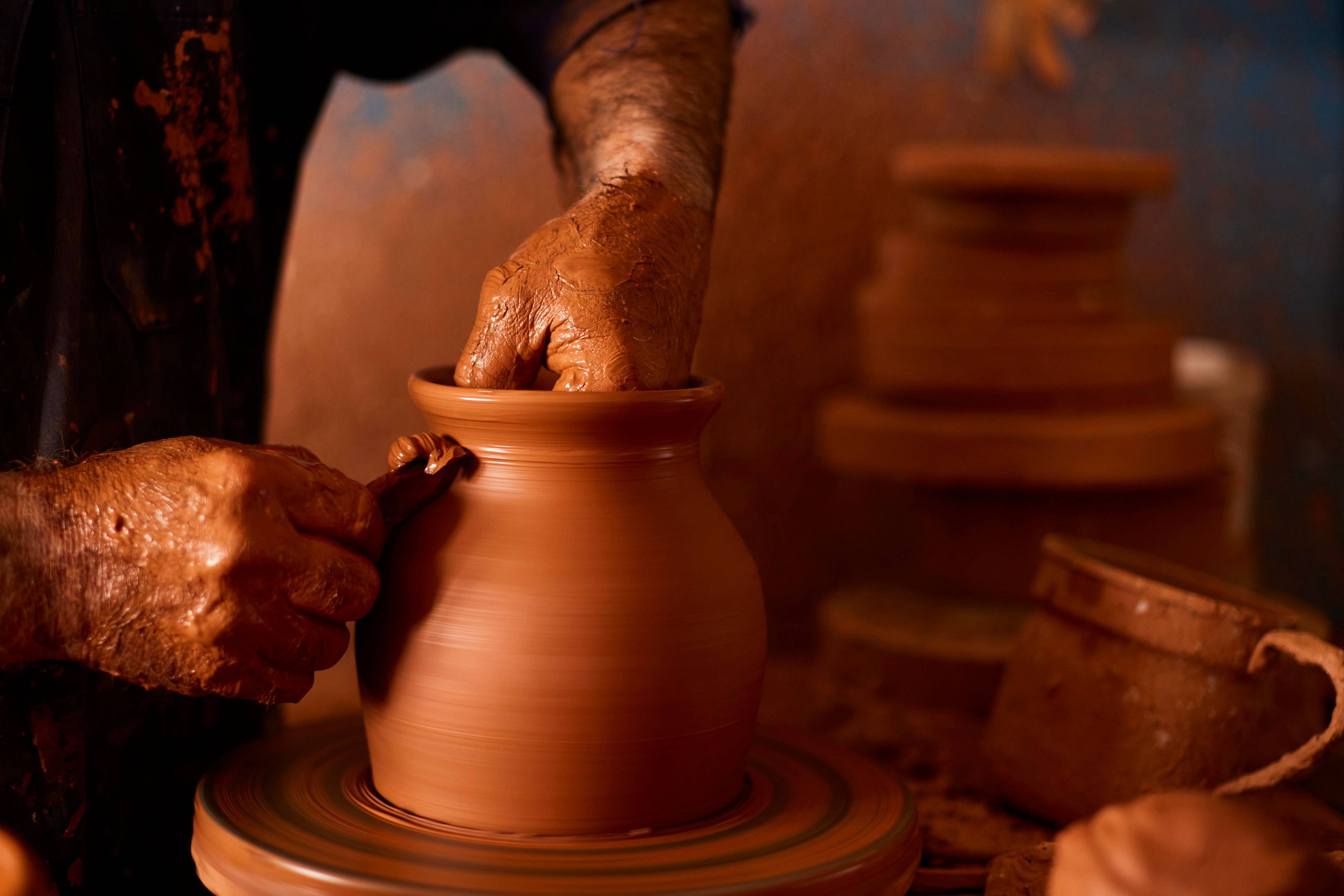
The term ‘pottery’ now refers to a set of techniques for the handmade production of clay pieces. In Viana do Alentejo, this is one of the defining features of the local cultural landscape. As the municipality's capital with over 5,000 inhabitants, Viana do Alentejo embodies in its material culture all the tradition and knowledge of generations embodied in its handicrafts. Much like the craft production of cow and sheep bells in Alcáçovas, now classified by UNESCO as Intangible Cultural Heritage in Need of Urgent Safeguarding, the pottery tradition of Viana do Alentejo constitutes – as its history and its key figures have consistently demonstrated – a unique context in Portugal, where pottery and ceramics have frequently intersected, under the guidance of the humblest of potters (such as Francisco Lagarto from Viana do Alentejo) and the most renowned of visual artists (such as Júlio Resende from Porto).
Following the vicissitudes of local history, pottery has retained its utilitarian character, with the forms that have come down to us and others that have since fallen into disuse or been lost from the collective memory. Bowls, plates and jugs are just a few examples of a tradition that continues to this day, but the most notable example is the ‘alguidar’ bowl. We can infer that this was introduced into the range of local pottery by the Arabs during their occupation of the Iberian Peninsula (18th–15th centuries). Alguidar bowls from Viana do Alentejo stand out from pottery produced in other centres due to their protruding rim, which makes it more ergonomic and, consequently, more sought-after.
When discussing pottery in this town of the Alentejo region, which in the mid-19th century had around 22 identified potteries, we must link the pottery tradition (the result of the intergenerational and familial transmission of knowledge within the workshop context) of ‘green clay’ (stoneware quarried at Herdade dos Baiões since 1255) to the ceramic tradition, which in turn has its foundations in the Médico de Sousa school. Founded on 28 October 1893, this was a workshop-school where virtually all the processes relating to the trades of potter, pottery kiln-worker and ceramic painter were taught. As one of the country’s first industrial schools, it would go on to weaken the generational bond of the family-based transmission of knowledge, since all those enrolled would have the opportunity to learn the techniques of working with clay, which had previously been confined to family circles.
Seeking to maintain its identity through traditional manual production processes (the potter’s wheel and auxiliary modelling tools, usually made in-house), which are inseparable from a patriarchal structure and a small-scale family economy, Viana do Alentejo’s pottery industry still grapples today with the chronic problem of a shortage of apprentices and the absence of economic and social conditions suited to the emergence of new production facilities. The two pottery courses, organised by Viana do Alentejo Town Council and the Institute for Employment and Vocational Training between 2017 and 2019, facilitated the transfer of knowledge, but the current climate has not been conducive to the emergence of new talents in the field of ceramics.
Text by Luís Banha, provided by the Viana do Alentejo Municipal Council.
Bibliography
- ALCINO, Aníbal, Um professor no Alentejo: crónicas, s.l., Câmara Municipal de Viana do Castelo, 1989.
- BANHA, Luís Miguel, ILARVS: Contributos para o estudo da olaria tradicional de Viana do Alentejo, Viana do Alentejo, Câmara Municipal de Viana do Alentejo, 2014.
- BANHA, Luis (2017). Olaria tradicional de Viana do Alentejo - Componente imaterial Acedido em: 20, abril, 2023, em: www.conhecerahistoria.pt
- BANHA, Luis (2017). Olaria tradicional de Viana do Alentejo - Componente material Acedido em: 20, abril, 2023, em: www.conhecerahistoria.pt
- PARVAUX, Solange, La céramique populaire du haut-alentejo, Paris, Presses Universitaires de France/Fundação Calouste Gulbenkian, 1968, 223 págs.
- SOUSA, João Manuel Santana de, História da Primeira Adega Social Portuguesa, Viana do Alentejo, Câmara Municipal, 1993.