map of Tibaldinho Embroidery
Tibaldinho Embroidery
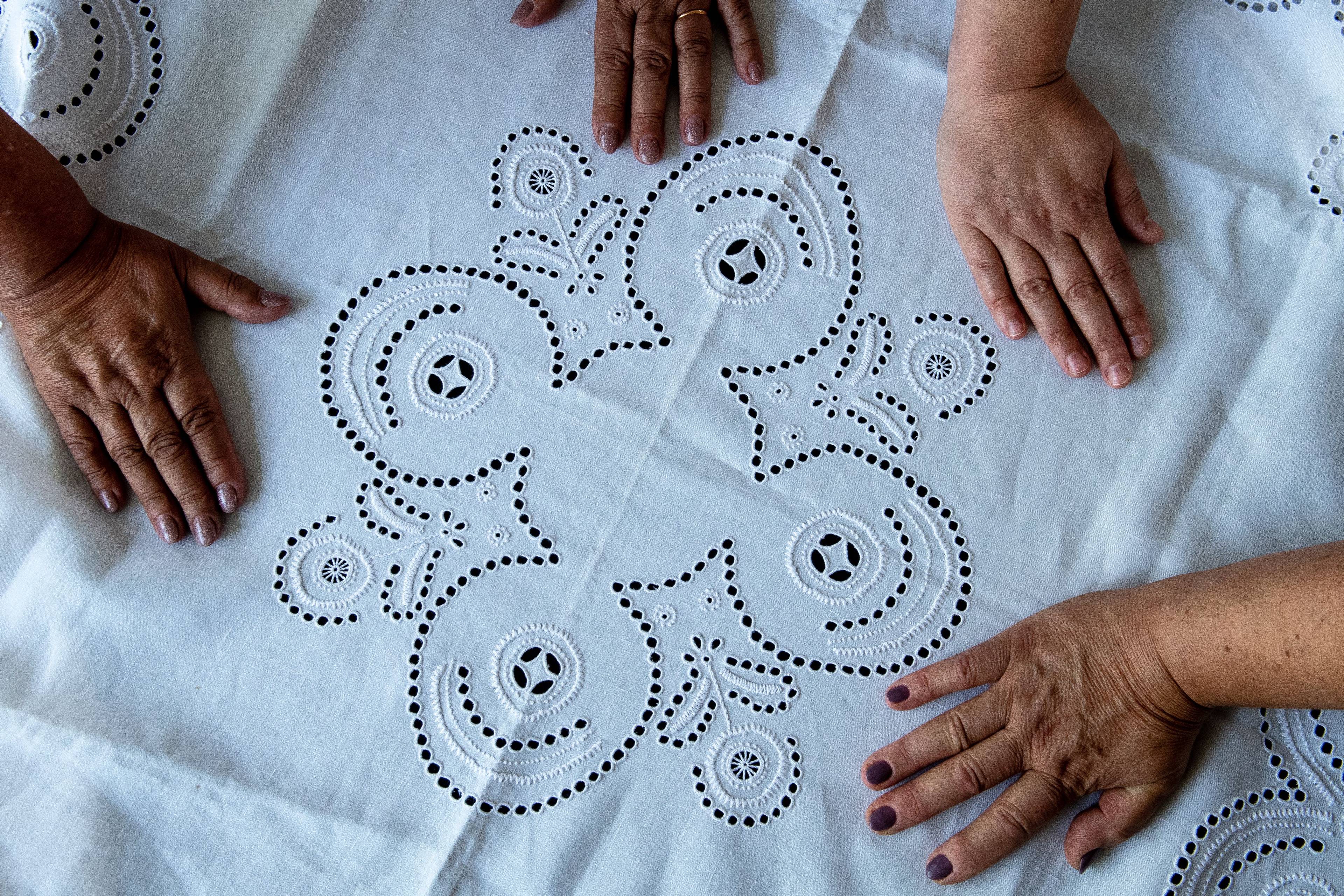
Tibaldinho Embroidery is a traditional craft originating in the village of Tibaldinho, in the parish of Alcafache, which has spread in recent decades throughout the municipality of Mangualde and into neighbouring areas of the municipalities of Viseu and Nelas. It is characterised by embroidery created using thread in shades ranging from white to ecru, on 100% cotton, 100% linen or half-linen fabric, also in the same colour palette.
The date of its origin is uncertain. Ana Pires cites 1929 as the date of the first written reference to this form of embroidery, in a text by Maria Júlia Antunes on the occasion of the 4th Beira Congress held in June 1929 in Castelo Branco (Pires, 1998). As early as 1922 this embroidery was already representing Portugal at the exhibition commemorating the first centenary of Brazil’s independence, held in Rio de Janeiro (Osório, 1997).
More systematic, market-oriented production of Tibaldinho embroidery is thought to have begun no earlier than the mid-1870s. It is thought to have been around 1875 that embroiderers in the Tibaldinho area ceased embroidering for their own use or that of their families and gradually began to embroider as a means of earning an income (Pires, 2009).
This production has always been characterised by the manufacture of various household textiles, including tablecloths and matching napkins, tea towels, hand towels, sheets, doilies, bread basket liners and decorative covers for furniture. It was only later that other types of items began to be embroidered, more closely linked to clothing, such as underwear, aprons, collars and cuffs for domestic service uniforms, and children’s clothing. Tibaldinho embroidery is also used on liturgical vestments and implements.
Although there is a combination of stitches that can be found in other forms of embroidery, what most distinguishes Tibaldinho embroidery is the use of eyelets. This consists of a hole cut open with scissors and subsequently finished with a cordonnet stitch, varying in size depending on the motif in which it is used and the effect the embroiderer wishes to achieve. Sometimes the buttonhole is also outlined with a shadow stitch or small knots. The ‘Enleio’ is another of the most distinctive motifs of Tibaldinho embroidery. It consists of a spiral of eylets, which can be more or less elaborate and come in various sizes.
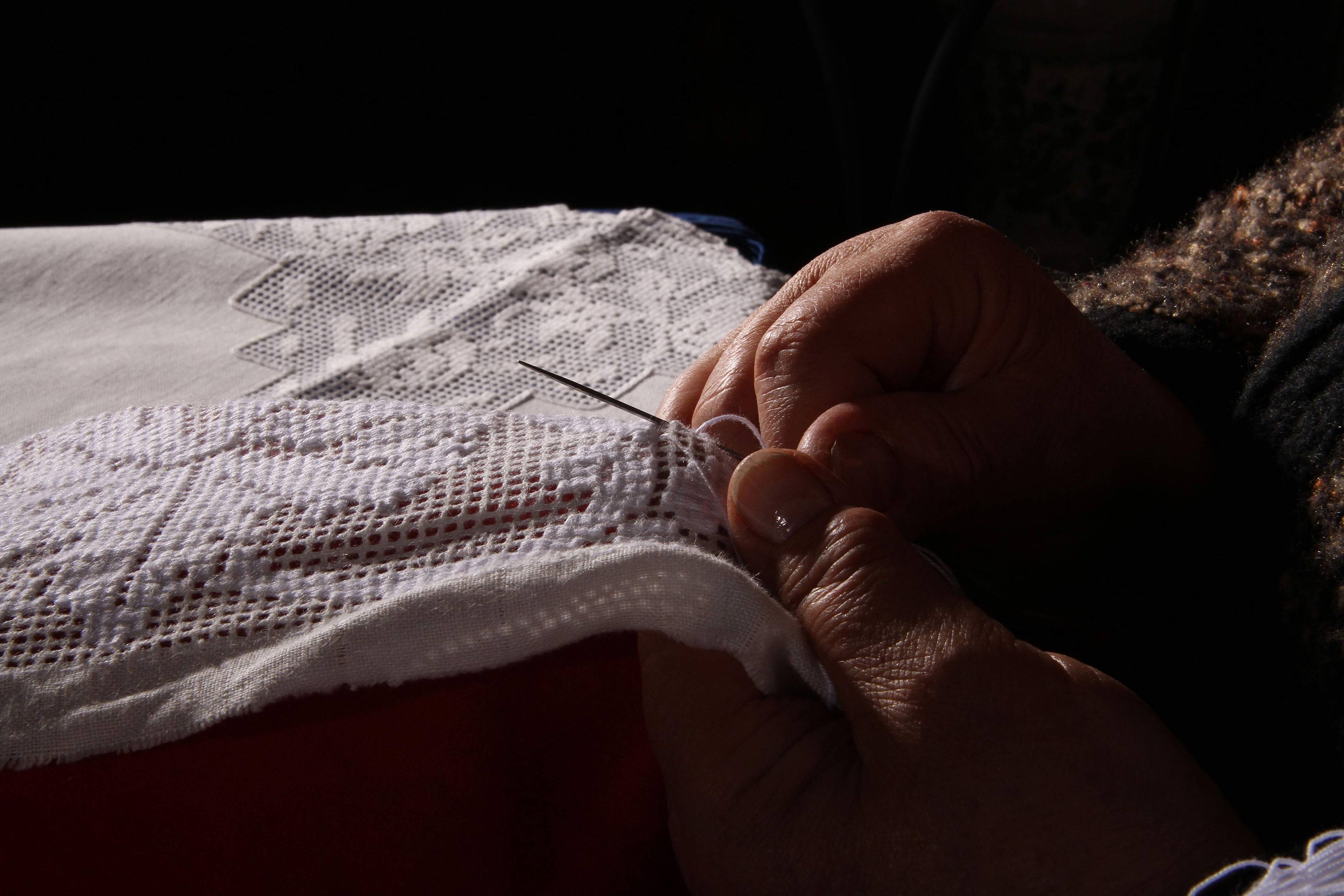
As with other types of embroidery, Tibaldinho embroidery begins by transferring the design onto the fabric using tracing paper. Once the piece has been embroidered, it is ‘trimmed’, removing any frayed edges left after the ‘crivos’ (drawn thread areas), eyelets and open sections have been created. It is washed by hand with natural soap and bleached in the sun to remove any visible marks left by the tracing. It is ironed while still damp after being soaked in starch diluted in water. The process is completed by trimming away the excess fabric beyond the outline that defines the piece’s finish.
This knowledge has been passed down through the female line, from generation to generation, both orally and through practice. In recent decades, the craft has also been passed on through training courses held every year in Tibaldinho, attended by women of various age groups and social backgrounds, including those from other parts of the municipality of Mangualde and neighbouring areas of the municipalities of Viseu and Nelas.
There are currently around fifty embroiderers keeping the craft alive, although it is clear that, for the younger generation, embroidery is a supplementary and occasional activity. Most customers visit the studio and showroom of Cidália Rodrigues, an embroiderer and trainer in the art, located on the main street of Tibaldinho, which plays a vital role in the promotion, preservation and marketing of Tibaldinho Embroidery.
Tibaldinho Embroidery has been a certified traditional craft since 2017, and an application for its inclusion in the National Inventory of Intangible Cultural Heritage has been submitted by Mangualde Municipal Council.
Text adapted from ‘Application for the Inventory of the Tibaldinho Embroidery-Making Process in the PCI – Annex I. Mangualde Municipal Council’.
Bibliography
- ALMEIDA, Fernando Louro de. «Bordados de Tibaldinho ou Bordados de Alcafache». Separata do Boletim Escolas Técnicas, n. º 35. Porto: Of. Gráf. Escola de Artes Decorativas Soares dos Reis
- Câmara Municipal de Mangualde; PEREIRA, Fernanda Mendes. Bordado de Tibaldinho - Caderno de Especificações. Mangualde: Câmara Municipal de Mangualde, 2017
- OSÓRIO, Ana de Castro. A grande aliança. Lisboa: Instituto Piaget, D. L. 1997
- PIRES, Ana. «O Bordado de Tibaldinho (um segredo bem guardado)». In Bordado de Tibaldinho. Lisboa: Câmara Municipal de Mangualde/ Instituto Português de Museus/ Museu Nacional do Traje, 1998, p. 15-28
- PIRES, Ana. “Tibaldinho Revisitado”. In Fios. Formas e memórias dos tecidos, rendas e bordados. Lisboa: IEFP, 2009, p. 183-193
- SILVA, José Manuel Azevedo. «Bordados de Tibaldinho». Separata da Revista Mundo da Arte, nº16, Coimbra: Instituto de História de Arte/ Faculdade de Letras da Universidade de Coimbra, 1983
- SILVA, José Manuel Azevedo. Bordado de Tibaldinho. Artesanato regional beiraltino. Mangualde: Câmara Municipal, 2003
- TEIXEIRA, Madalena Braz. «As Origens do Bordado de Tibaldinho». In Bordado de Tibaldinho. Lisboa: Câmara Municipal de Mangualde/ Instituto Português de Museus/ Museu Nacional do Traje, 1998, p. 7-14