map of Silk
Silk
Silk is a fibre made from a protein filament expelled by the sericeous glands of silkworm caterpillars and has become one of the most valuable textile raw materials. The discovery of silk production dates back some 5000 years and originated in China. Sericulture involves the cultivation of the mulberry tree, the rearing of silkworms and the production of silk threads for the textile industry.
The world’s four largest silk producers are China, Japan, Brazil and India. Around 95% of the silk produced in the world comes from the Bombyx mori caterpillar, also known as the silkworm.
For centuries, the Chinese protected the secret of silk production with severe penalties. However, this did not prevent it from later becoming one of the most traded precious commodities between the East and the West, along the various routes that came to form the Silk Road – a vital link not only for trade but also for the flow of scientific knowledge, technological innovation, and cultural and artistic practices.
Although there are no documents attesting to the exact dates of the introduction of the silk industry in Portugal, some authors note that, as early as the reign of King Afonso Henriques, Lisbon was recognised as an important centre for silk production. In the Trás-os-Montes region, during the reign of King Sancho II, there are historical records relating to a surge in the planting of mulberry trees and the rearing of silkworms (AZEVEDO et al.: 166).
After various ups and downs over the centuries, it was likely due to the protectionist measures introduced by the Marquis of Pombal that the silk production industry enjoyed a period of rapid development, with the establishment of the Royal Silk Factory in Lisbon, located in the Águas Livres neighbourhood. The construction of the factory was accompanied by the creation of the Jardim das Amoreiras, where 331 mulberry trees were planted, next to the Silk Weaving Mill (now the premises of the Arpad Szenes-Vieira da Silva Foundation Museum).
Part of this plan to boost silk production relied upon the encouragement of mulberry tree planting and silkworm rearing throughout the kingdom, in order to secure a market for the silk produced (AZEVEDO et al: 170). In the 18th century, Trás-os-Montes remained the region of the country with the highest level of activity in this sector, with the planting and distribution of thousands of mulberry trees for silkworm rearing recorded in Moncorvo and Freixo de Espada à Cinta. In 1788, schools for silk production and spinning were established in Bragança, the first of which was in Chacim, where a spinning mill was set up.
Despite all attempts to modernise the silk industry in Portugal from the 19th century onwards, several factors contributed to its almost total decline, including a fragile business sector, a lack of financial investment, a shortage of skilled workers, an inability to compete with lower-cost foreign production, the rise in demand for other, more practical and cheaper fabrics such as cotton and the lack of demand for luxury fabrics in a small country with an impoverished population, accustomed to ‘burel’ and homespun linen fabrics (SOUSA, 2006b).
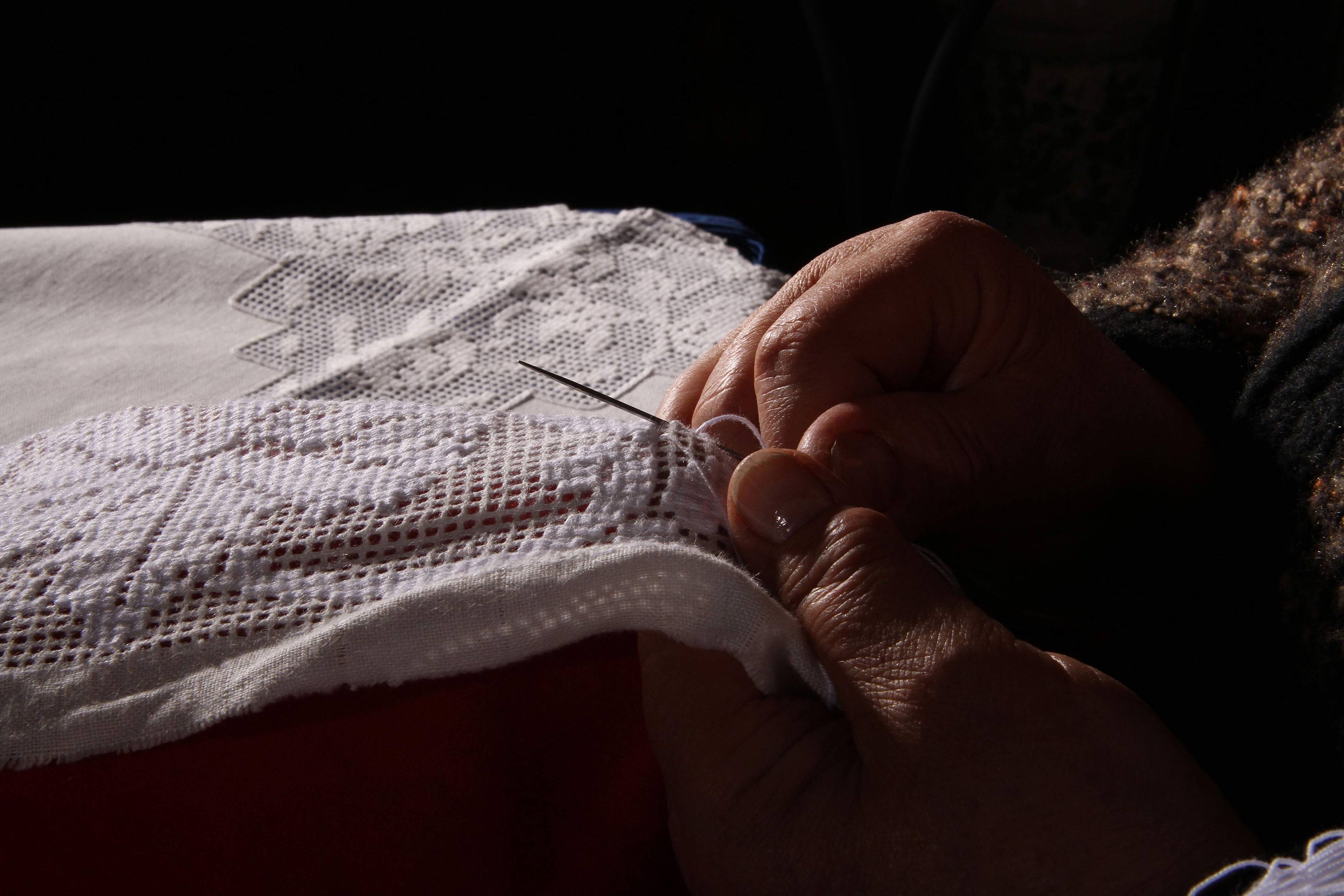
Silk production in Portugal has endured as an artisanal practice carried out mainly in the home and largely confined to a few regions of the country. Currently, the few remaining centres of silk production in Portugal are in Freixo de Espada à Cinta and Castelo Branco. Although these are two very distinct examples, both in terms of production and processing methods and their historical backgrounds, they share the common feature of combining production with a museum component: in the first case, through the Museu da Seda e do Território (Silk and Territory Museum); and in the second, through the Museu da Seda da Associação Portuguesa de Pais e Amigos do Cidadão Deficiente Mental (Silk Museum of the Portuguese Association of Parents and Friends of People with Intellectual Disabilities) (APPACDM). Thanks to the efforts of the municipality of Freixo de Espada à Cinta, silk production and weaving continue in Trás-os-Montes, carried out entirely by using traditional methods. APPACDM in Castelo Branco has adopted this activity as a form of occupational therapy for its service users, producing around 15 kilograms of extra-quality silk and 15 kilograms of wild silk annually, using mechanised processes. This silk only partially meets the local demand for raw materials for what is one of the arts most closely linked to the cultural identity of this region: Castelo Branco embroidery.
Rearing silkworms on a domestic scale is a process that requires constant monitoring and care. After the butterflies have mated, each female lays around 300 eggs. These are first placed in cardboard boxes, lined with white paper, in the warmest room of the house. From mid-March onwards, the larvae hatch and are placed on trays, together with very tender mulberry leaves to feed on. It was common to use wooden bread trays, with the base lined with newspaper. The quantity and abundance of food determines the speed at which the larvae mature, a process taking around 25 days. Once they reach adulthood, the caterpillars begin to spin their cocoons. Pine or oak branches are placed next to the trays, attracting the caterpillars, which then begin to spin their cocoons there over a period of about three days. The cocoons are removed from the branches before the butterflies emerge breaking the cocoon and, consequently, the silk thread. A selection of male and female cocoons is set aside for future breeding, while the remainder are exposed to the sun to kill the pupae still inside.
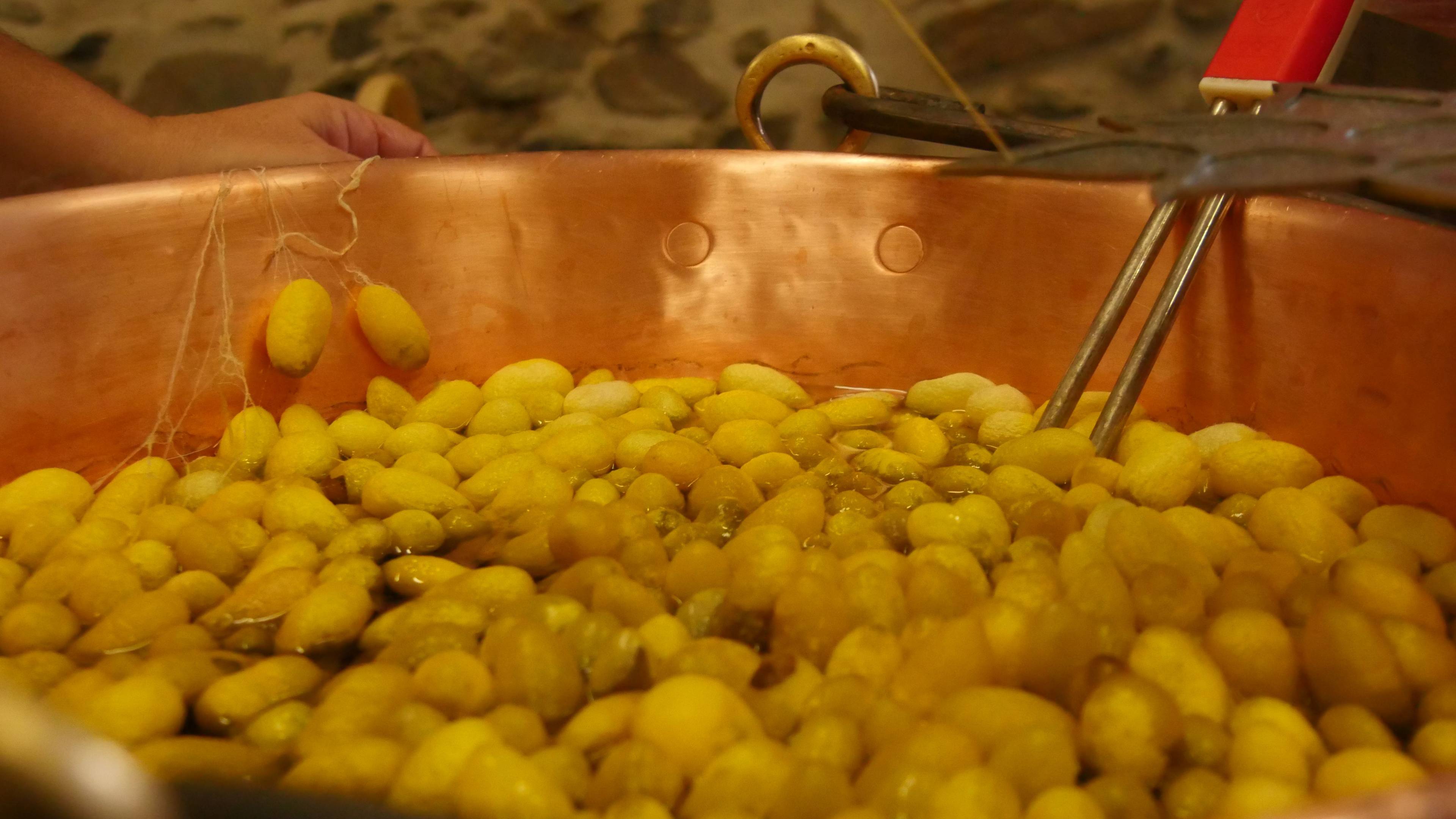
The cocoons are cleaned by hand and placed in boiling water to dissolve the gum that coats them. The cauldron is removed from the heat and the process of extracting the threads begins, using a branch of 'carqueija' (a native broom-like shrub) and a reel onto which the filaments are wound. This is followed by spinning, as the final thread is produced by twisting and stretching several filaments together. The skeins are formed from the yarn. After a careful process of washing, bleaching and drying, the skeins are wound into balls using a 'dobadoura' (yarn winder). For weaving, a thicker yarn is used; for embroidery, the yarn is finer and will also undergo a dyeing process.
Bibliography
- AZEVEDO, Jorge; MASCARENHAS, Maria Alexandra; MASCARENHAS, Ana (2015a). História da sericicultura em Portugal. Desde o início do Século VIII até final do Século XVIII. Comunicação apresentada no 1º Encontro de História da Ciência no Ensino [disponível em ruralbit.com]
- AZEVEDO, Jorge; MASCARENHAS, Maria Alexandra; MASCARENHAS, Ana (2015b). História da sericicultura em Portugal. Origem e utilização atual dos bichos-da-seda e da seda. Comunicação apresentada no 1º Encontro de História da Ciência no Ensino [disponível em ruralbit.com]
- AZEVEDO, Jorge; MASCARENHAS, Maria Alexandra; MASCARENHAS (2015c), Ana. História da sericicultura em Portugal. Desde o início do Século XIX até ao início do século XXI. Comunicação apresentada no 1º Encontro de História da Ciência no Ensino [disponível em ruralbit.com]
- MAGALHÃES, Alberto da Conceição (2010). A Real Fábrica das Sedas e o Comércio Têxtil com o Brasil (1734-1822). Tese de Mestrado em História dos Descobrimentos e da Expansão. Lisboa: Faculdade de Letras/ Universidade de Lisboa [disponível em repositorio.ul.pt]
- SOUSA, Fernando de (2006a). A Indústria das Sedas em Trás-os-Montes, vols.1 e 2. Porto: Edições Afrontamento, 2006 [disponível em cepese.pt]
- SOUSA, Fernando (2006b). A Indústria das Sedas em Trás-os-Montes (1790-1820). Estudos em Homenagem ao Professor Doutor José Marques, vol.2. Porto: FLUP [disponível em ler.letras.up.pt]
Webgrafia
- História da Seda. Centro de Ciência Vida de Bragança [disponível em braganca.cienciaviva.pt].
- Real Fábrica das Sedas e Fábricas Anexas. Arquivo Nacional da Torre do Tombo [disponível em digitarq.arquivos.pt].
gallery
Arts
Learn more
Itinerary: Silk Thread