map of Redondo Pottery
Redondo Pottery

Redondo’s decorated pottery is a marketable craft, produced in workshops by potters and painters and involving various tasks within a long production cycle.
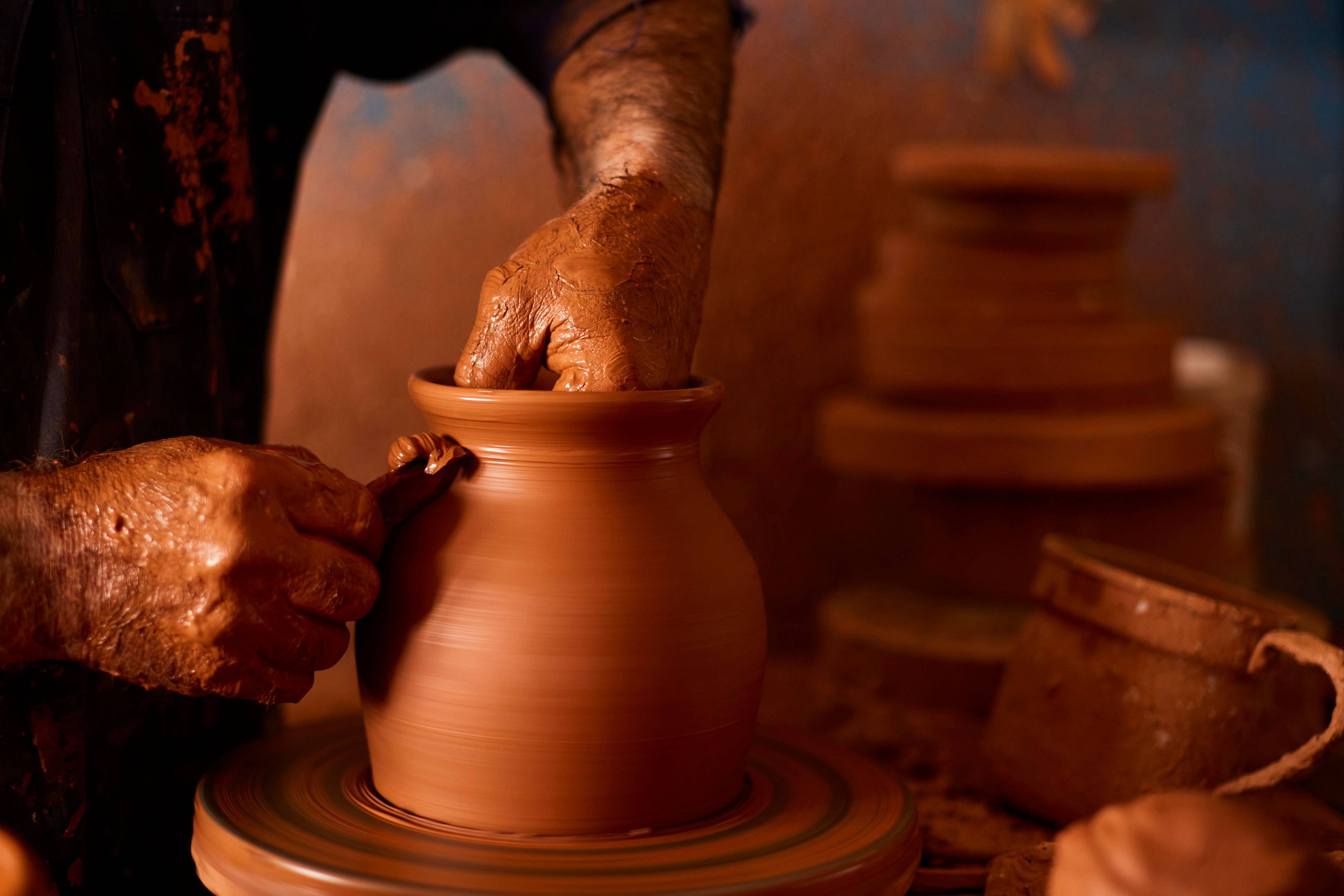
The potters work solely in the village of Redondo, in small workshops scattered throughout the village, following a traditional production method using the potter’s wheel. Only one pottery workshop uses local-sourced clay exclusively. Today, production is focused on the manufacture of open-form pieces, decorated plates and bowls, with only the Poço Velho Pottery producing mainly utilitarian items.
The clay is shaped on a potter’s wheel (today usually electric) and left to air-dry. It is then fired for the first time, usually in an electric or gas kiln, while the Poço Velho pottery still uses a traditional wood-fired kiln.
Decoration involves various techniques: sgraffito, painting, spattering, slapping, dripping, dipping, running and immersion. Decoration is always applied to a surface coated in white engobe (slip) after the first firing, as a light, opaque base is required for the pigments to stand out.
To colour the surface of the pottery, oxides and high-fire paints are currently used, although the former are in sharp decline due to the difficulty in fixing them properly.
Painting involves using a brush to apply coloured pigments to the ceramic surface, onto which traditional motifs such as floral designs and rural scenes are sketched beforehand, though these may also be created spontaneously.
Traditional oxides are always applied over the lead-based glaze on pieces coated with white engobe, requiring firing at around 900°C. The traditional colours are yellow and copper oxide green. The oxides applied to the glazed surface are quickly absorbed, resulting in a very subtle colours. The rim of the plates is painted at the end, with the painter spinning the plate on their hand.
When painting with high-firing glazes, the colour range is much broader. The glaze is applied afterwards and the pieces are then prepared for the final firing in a muffle kiln at over 900°C. After this, the pieces are ready.
These techniques have been applied to various types of wheel-thrown pottery since the late 19th century, reaching their peak between the 1940s and 1960s, and have since declined to the present day.
The Municipality of Redondo has been actively promoting and seeking to preserve traditional pottery, an important element in shaping local identity.
Text provided by Redondo Town Council.