map of Nisa Pottery
Nisa Pottery
Stone-incrusted pottery is a tradition with deep and historic roots in Nisa. Stemming from the need to store and transport water, it forms part of the Alentejo’s rich pottery tradition.
During the second half of the 20th century, the utilitarian function of stone-incrusted pottery was superseeded by its decorative function. During this period, the artisans began to create pieces that went beyond mere utility and became decorative items. Plates, serving dishes, miniatures and animal figurines were added to the traditional jugs, jars, pitchers and small jugs. The creativity of the artisans from Nisa is evident in the complex decorations and their skill in using stones of three different size categories to create intricate patterns.
The process of making Nisa pottery involves several meticulous stages. It begins with the extraction of the clay, which is used to produce the body. This clay body is prepared in workshops, where the clay is mixed with water and impurities are removed. The black and white clays used to make the clay body are sourced locally. From there, the clay goes through stages such as shaping, decorating and firing.
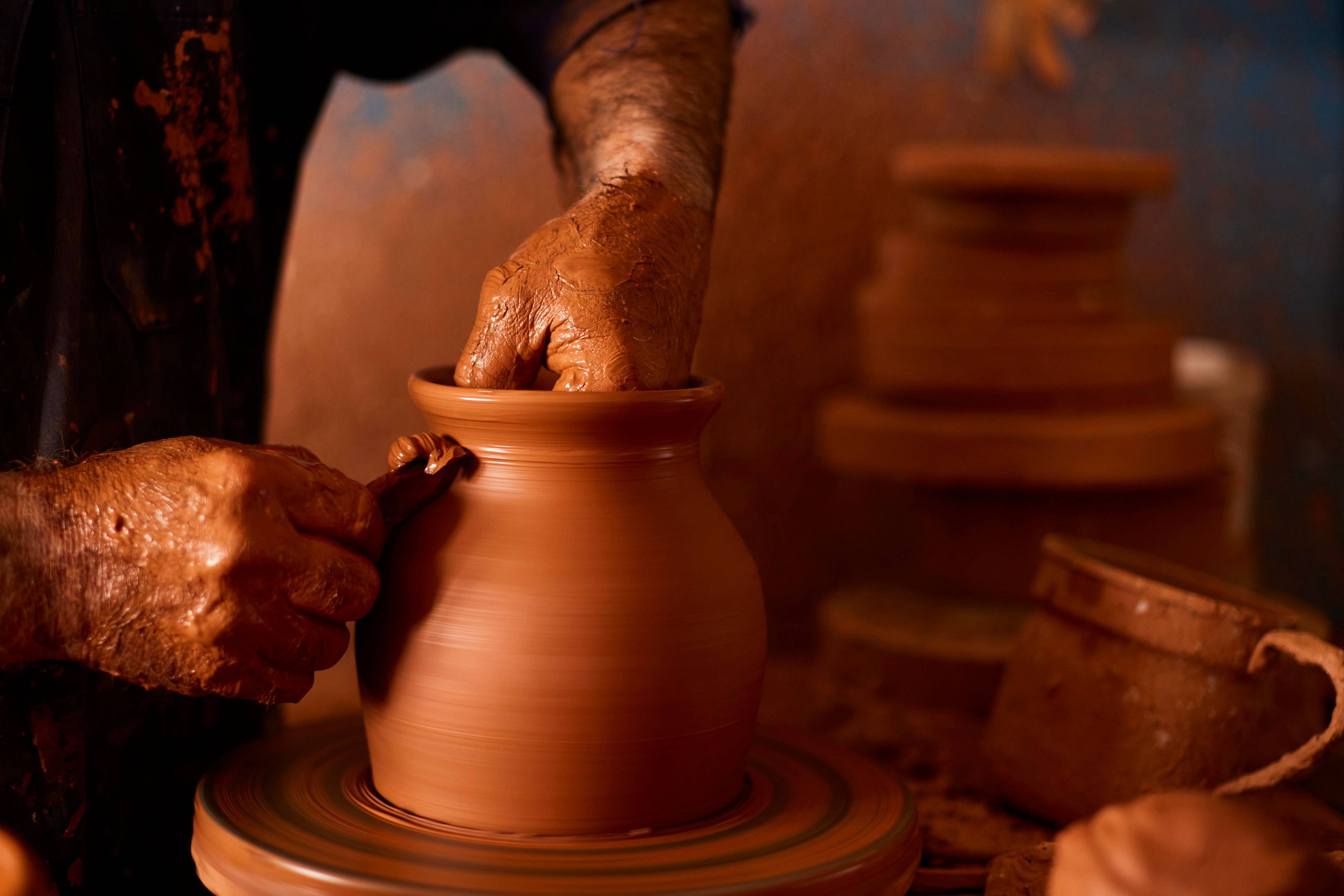
The shaping of the pieces is a process that varies among the artisans. Some use a traditional foot-powered potter’s wheel, while others use an electric wheel. Traditional techniques include the use of the ‘atoquina’, a kind of workbench, and the ‘barranhão’, a clay container filled with water for wetting the hands. Finishing the piece involves tools such as the ‘aplanata’, a piece of felt. The piece is then removed from the wheel using a wire or string tied to a stick and taken for ‘enxugo’, the initial drying stage.
The decoration of the pieces is a fundamental aspect of Nisa pottery. The process begins with the piece being dyed by immersing it in ‘engobe’, made by diluting red clay in water.
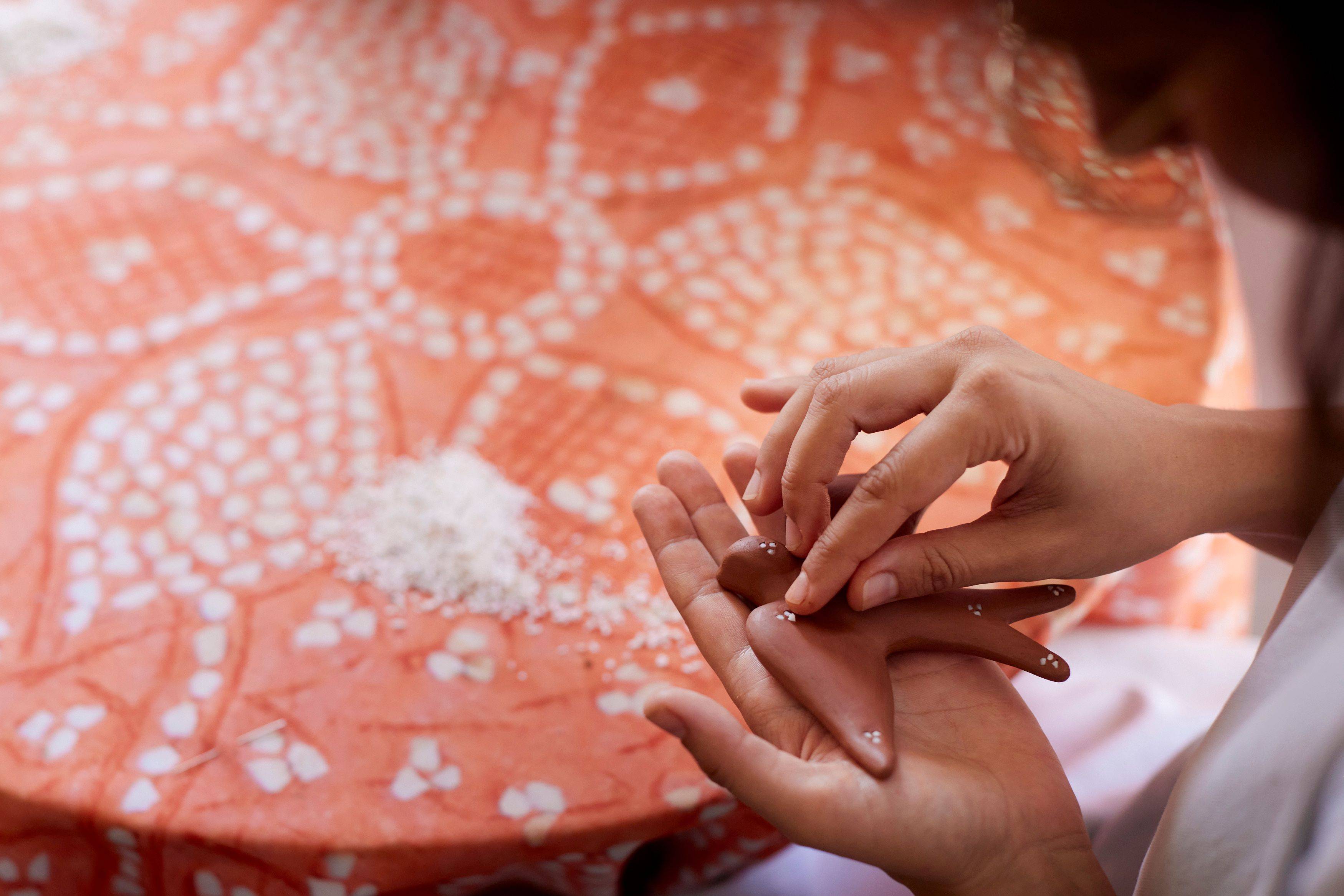
Next comes the process of inlaying, carried out by the inlayers – a task performed mainly by women – in which milky quartz stones are placed one by one into the clay piece. This technique, known as ‘empedrado’, is a striking and easily identifiable feature of Nisa’s pieces. The designs are transferred onto the piece using sewing needles, thimbles and lamp sockets, and filled one by one with the milky quartz stones extracted from the Serra de São Miguel which were fired to make them more brittle.
Decorative motifs include a variety of elements, ranging from roses and marigolds to acorns, wheat ears and clusters of stones arranged in triangles known as ‘aranhas’ (spiders). The ‘empedrado’ technique of inlaying stones, which has been documented in the Iberian Peninsula since the 16th century, is one of the highlights of this tradition. It is important to note that in Portugal, the technique is practised exclusively in the three potteries located in the village of Nisa.
The pieces are fired in gas kilns, where they are subjected to temperatures of between 800°C and 900°C for around eight hours. This process marks the completion of the production cycle for these works, which have long since become an iconic symbol of the village of Nisa.
In order to preserve and foster the Nisa pottery tradition, the local council plays an active role in promoting and protecting this heritage. This includes organising courses and exhibitions, as well as providing logistical support to the artisans who possess this valuable knowledge.
Text provided by Nisa Town Council.
Bibliography
- RIBEIRO, Margarida. A Olaria Tradicional Portuguesa: Colecção de Margarida Ribeiro. [Catálogos]. Oficinas do Convento - Associação Cultural de Arte e Comunicação, [Montemor-o-Novo]: Oficinas do Convento, 1998.
- CARNEIRO, Eugénio Lapa. Empedrado: Técnica de Decoração Cerâmica. (Fichas de Olaria; 1). Câmara Municipal de Barcelos, Museu de Olaria, Barcelos, 1989.
- CARNEIRO, Eugénio Lapa. O Museu de Cerâmica Popular Portuguesa Será uma Realidade Porque Era e É de Fato Desejado por Muitos. Museu de Cerâmica Popular Portuguesa, Barcelos, 1969.
- CARNEIRO, Eugénio Lapa. O Fim da Olaria Tradicional Portuguesa. Separata do Colóquio 2, Tomo III, das Publicações XXIX Congresso Luso-Espanhol, Lisboa, 31 de março a 4 de abril de 1970.
- CHAVES, Luis. Nos Domínios da Arte e da Artesania: Olarias Rústicas e Cerâmicas Artísticas. Revista Etnos, Vol.IV, 1965.
- CHAVES, Luís. Do Barro se Faz Loiças; Na Loiça se Come o Trigo…. Edição da Federação Nacional dos Produtos do Trigo, Lisboa, 1953.
- CHAVES, Luis. Cerâmica. In: Lima Fernando de Castro e Pires, A Arte Popular em Portugal, Vol. 2. Editorial Verbo, 1972.
- CHAVES, Luís. Cerâmica Popular de Nisa: Contribuição Etnográfica. Revista de Etnografia, nº 1, julho de 1963.
- CID, Manuel. Bibliografia de Etnografia Alentejana. Delegação Regional do Alentejo da Secretaria de Estado da Cultura, Évora, 1993.
- DIAS, Jorge. Da Olaria Primitiva ao Forno do Oleiro. Revista de Etnografia, vol. IV, Tomo 1, p.7, 1965.
- FIGUEIREDO, José Francisco. Monografia de Nisa. Imprensa Nacional Casa da Moeda, Câmara Municipal de Nisa, edição fac-similada de 1956.
- FERNANDES, Isabel Maria. Introdução à Conferência de Luciano García Alén: O Paso de Oleiros Portugueses a Galici: A Sua Viaxe polo Derradeiro Século. (Museu Aberto; 2). Câmara Municipal de Barcelos, Museu de Olaria, Barcelos, 1990.
- Festa Ibérica da Olaria e do Barro - V. Câmara Municipal de Reguengos de Monsaraz, S. Pedro do Corval, maio de 1999.
- LEAL, Pinho. Portugal Antigo e Moderno. Lisboa, 1874.
- MATOS, Sebastião (dir.). Olaria: Estudos Arqueológicos, Históricos e Etnológicos. Museu de Olaria. Câmara Municipal de Barcelos, Barcelos, 1996.
- MEIRA, Alberto. Cerâmica Portuguesa: Bibliografias e Notas. Porto, 1953.
- MOURA, José Diniz da Graça Motta e. Memória Histórica da Notável Vila de Nisa. Imprensa Nacional Casa da Moeda, Câmara Municipal de Nisa, edição fac-similada de 1855.
- Olaria. Boletim do Museu de Cerâmica Popular Portuguesa, n.º 1, Barcelos. Câmara Municipal Lisboa; Livraria Portugal [distrib.], 1968.
- PARALTA, M. de Lourdes Seabra de Mascarenhas. Memorial em Verso da Notável Vila de Nisa, Sua História, Gentes, Usos e Costumes. Edição da autora, 1982.
- PEIXOTO, Rocha. “Obras”. Museu Municipal do Porto. Ensino. Política. Ensaios Diversos. Economia. vol. II, Edição Câmara Municipal de Póvoa do Varzim, 1972.
- PICÃO, José da Silva. Etnografia do Alto Alentejo. Portugália, Tomo I, 1903.
- QUEIRÓS, José. Cerâmica Portuguesa e Outros Estudos. Editorial Presença, Lisboa.
- RIBEIRO, Emanuel. Anatomia da Cerâmica Popular Portuguesa. Imprensa da Universidade de Coimbra, 1927. Coleção Subsídios para a História da Arte em Portugal.
- RIBEIRO, Margarida. Instrumentos Auxiliares de Modelação, Subsídios para o Estudo da Olaria Portuguesa. In: "O Arqueólogo Português", Série III, vol. III, 1969.
- RIBEIRO, Margarida. Engenho de Amassar o Barro, Subsídios para o Estudo das Técnicas da Olaria Popular. Série III, vol. VI, 1972.
- VASCONCELLOS, J. Leite de. Matéria Filológica – Etimologia de Nisa, in: Brados do Alentejo, nº 333, 13, 1937.