map of Linen
Linen
Common name(s) in Portugal
Linho, linho-galego, linho-mourisco, linho-riga-nacional
Scientific name
Linacae - Linum usitatissimum L.; Linum bienne Mill.
Distribution across the national territory
Flax is found throughout the Portuguese territory, in a diversity of species. Flax grown for textile use as linen (which is more fibrous) prefers cool, humid climates, while oilseed flax (for the production of linseed oil) is found in more temperate and warm climates (D’Ambrosio et al., 2018). It is found in perennial or annual meadows, clearings in scrubland and on the verges of paths. It grows in cool locations and in soils with some moisture, which are generally deep. It flowers from February to June (Flora-On).

Linen is a plant fibre derived from herbaceous plants of the Linaceae family. The stem of these plants contains very strong fibres (up to 90 cm in length, with diameters between 12 and 16 microns), which, after undergoing a series of processing stages, are transformed into the yarn used in the production of textiles.
These processing stages refer to the series of steps that make up the lengthy process of transforming plant fibres into yarns for weaving and embroidery.
Although it grows wild across much of the country, flax has been cultivated most extensively in the north and centre of the country, where the climate, which is wetter and cooler, is better suited. The most common species cultivated are common flax (Linum usitatissimum L.) and so-called Galician flax (Linum bienne L.), which has other regional names such as wild flax, earth flax, winter flax and Moorish flax.
The origins of the use of flax fibres in the production of fabrics are unclear. The earliest reference is attributed to Egypt, where flax was widely cultivated and used. Archaeological remains dating from the Pre-dynastic Period (5000 BCE) demonstrate, through the quality of the fabrics, a profound understanding of the techniques involved.
The earliest evidence of its cultivation and use in Portugal dates from the Bronze Age (2000 BC), in the Monchique mountain range. The history of flax is well documented, which highlights its importance, particularly from the Middle Ages onwards. Linen, whether in bundles of fibres or already woven into cloth, served as a form of currency. However, the lack of investment in the systematic development of this crop led to a decline in its importance from the 15th century onwards. ‘Bragal’, the name given to the national linen cloth, was of a coarse texture. Fine linen cloths were imported and known as ‘lenço’. The industrialisation of the national textile production, spurred on by Pombaline policies from the 18th century onwards, did not extend to linen, which continued to be produced on a domestic and small-scale basis. It was not until the mid- 19th century that a factory dedicated to linen fabrics was established in Torres Novas. Between the 1940s and 1980s, flax cultivation was developed for industrial purposes, using imported seeds, which were more productive than the local varieties.
The most widely grown varieties of Portuguese flax are Galician flax, Moorish flax and Riga Nacional flax. Other regional names usually refer to one of these three varieties.
‘Galician flax is the most widespread and predominates in the districts of Viana do Castelo, Braga, Porto, Aveiro, Viseu, Vila Real and Guarda. It thrives in cool soil and a humid climate (...). It is a spring variety that is sown in April or early May and harvested in June. Moorish flax is predominant in the districts south of the Tagus, as well as in those of Bragança, Santarém and Castelo Branco. The fibre is longer than that of the Galician variety, but darker and coarser. It is able to adapt to clayey or even very poor soils. It is a winter variety, sown after the first rains, in October and December, and harvested in May. “Riga Nacional” is rarely cultivated, being found only in the district of Guarda and other parts of the Minho region. The fibre of this flax is longer and less fine than that of the Galician variety, and shorter and finer than Moorish flax. It is also a spring variety.’ (PEREIRA, 1985: 6).
The sowing season varies slightly from region to region, falling between March and April. Germination takes place in around 4 days. The plant takes around two months to grow and mature. It is essential to know the exact point of maturity in order to harvest the crop, which is done manually by pulling the plant up by the roots, usually between May and June during a dry spell. The flower should have withered, giving way to closed capsules containing the seeds, and the stems should have turned yellow. The flax is spread out in the sun for one or two days to dry before being combed using a combing board or ‘ripo’ – a wooden board with teeth through which the stalks are passed – to separate the seeds (linseed).
This is followed by retting, during which the bundles of stalks are submerged in water – in streams or tanks known as ‘aguadeiros’ – to macerate and dissolve the outer material surrounding the fibres, allowing them to be separated. This stage takes between 7 and 12 days, depending on the water temperature. Finally, the flax is washed to remove all impurities from the fibres. Drying takes between 8 and 15 days, during which the flax is spread out in the sun.
The next stage, known as processing, comprises several phases: the selection of the stalks, choosing the longest and most intact ones, during which the unwanted fibres are removed using a comb with coarse vertical teeth, while the good ones are kept by hand; beating (‘masgado’), which separates the shives from the fibres by striking the bundles of flax with a wooden mallet or a stone with a uniform surface, along the entire length of the fibres. This process could also be carried out using animal-drawn or hydraulic machinery. Each bundle is twisted and kneaded ('moído') to complete the removal of any remaining shives. ‘Espadelagem’ or scutching completes the process of cleaning the flax fibres by beating bundles with a wooden paddle with a sharp edge against a wooden block, thereby freeing them from the last traces of impurities. During this process, the ‘tascos’ – thicker, broken fibres – are also separated; these are spun and used to produce coarse fabrics such as burlap or sackcloth; after that, the scutched flax is passed through the 'sedeiro', a stage known as combing, in which the bundles of fibres are passed through a comb with polished and sharpened iron or copper teeth, fixed to a wooden block. The spacing between these teeth, which can be more or less tight, varies depending on the desired fineness of the flax, and the flax is passed through several combing machines until the finest yarn is achieved. The fibres removed at each combing stage are used to make fabrics of intermediate thickness, known as tow (‘estopa’ or ‘estopinha’). Finally, the flax is is twisted into a bundle (‘estriga’), and is then ready to move on to the spinning stage.
Spinning is the process of making yarn or thread from the fibres. In traditional craft production, a spinning wheel and a spindle, or a spinning wheel, are used. The distaff may be made of wood or cane, consisting of a shaft with a conical-shaped head to which the fibres ready to be spun are attached. The handle of the distaff is fastened to the waistband of the apron. Distaffs and spindles are made by carpenters. They could also be made by the men of the household or by young men who would give them as gifts to their girlfriends. After spinning, the yarn is wound into skeins using a cross reel (‘sarilho’ or ‘zangarilho’).
The skeins of flax then undergo a bleaching process, which varies according to local practice. This may involve cooking them in a low-heat oven or in boiling water, after the skeins have been soaked in ash or animal dung. After being washed and cooled, the skeins of flax are left to dry and bleach in the sun. Once dry, the flax is wound into balls using a 'dobadoura' (yarn winder), and the yarn is ready for being woven on the loom (EPFBM/CEEV, 1983).
The tools associated with the flax-processing and weaving processes take on a symbolic character and, in many cases, possess an aesthetic dimension that varies from region to region. This is evident in the decoration of scutching implements, distaffs and spindles. Furthermore, the terminology relating to the different stages and the preferred shapes of some of these tools has variations specific to each locality.
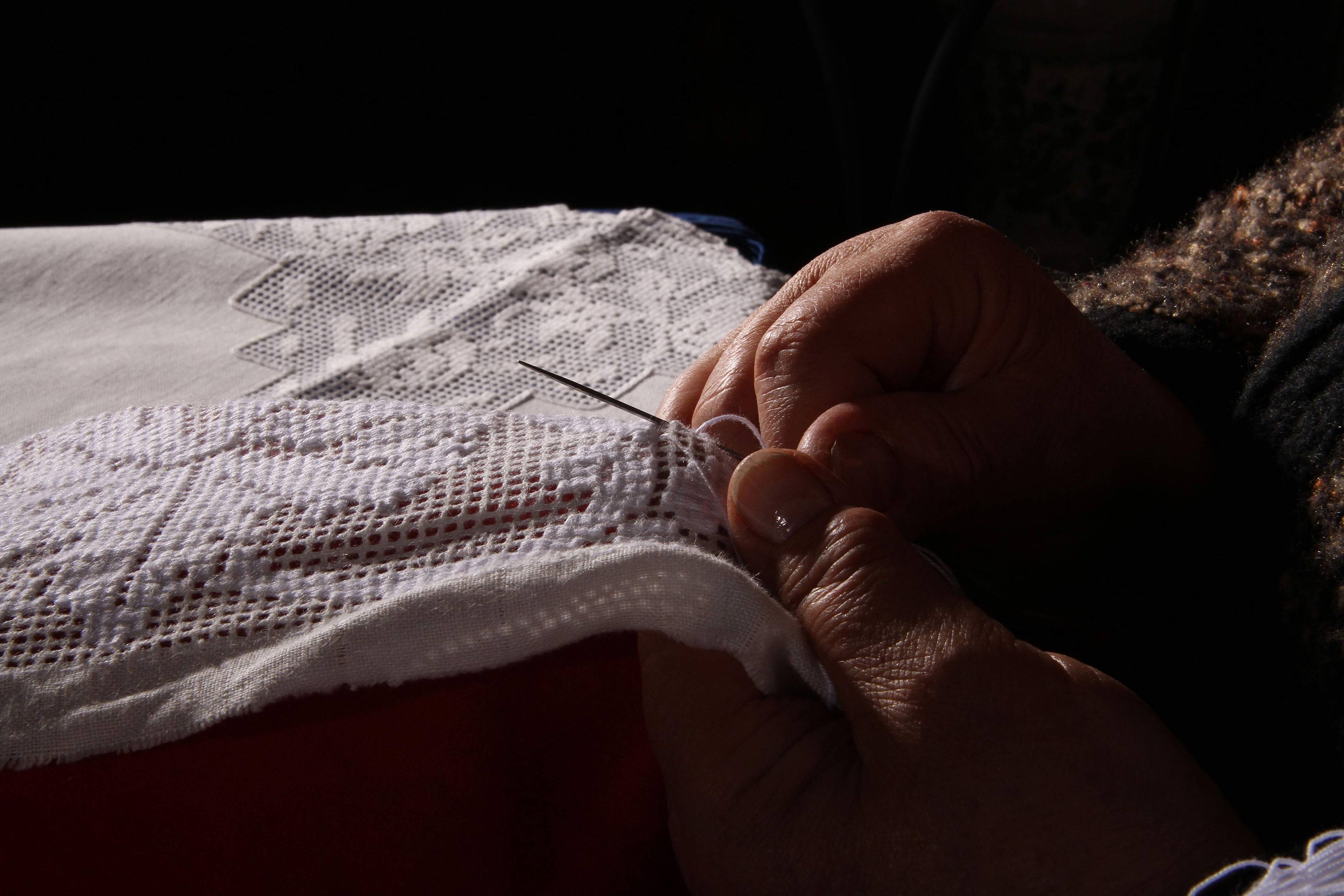
Linen fabrics, which were essential for centuries for clothing and domestic life, vary in quality depending on the yarn from which they are made, and can be divided into two main categories: linen fabrics and burlap fabrics. These two categories include a variety of fabrics, ranging from very fine cambric to coarse canvas.
With the introduction of cotton yarn into the textile industry and manufacturing, blended fabrics – such as linen and cotton, and linen and wool – became commonplace.
Bibliography
- ESCOLA PREPARATÓRIA DE FREI BARTOLOMEU DOS MARTIRES/CENTRO DE ESTÁGIO DE EDUCAÇÃO VISUAIS (1983). Artes e tradições de Viana do Castelo. Coleção Arte e Artistas, n.º4. Lisboa: Terra Livre/DGD.
- ESCOLA PREPARATÓRIA DE BRAGANÇA/ CENTRO DE ESTÁGIO DE EDUCAÇÃO VISUAL (1984). Artes e Tradições de Bragança. Coleção Arte e Artistas, n.º7. Lisboa: Terra Livre/DGD.
- OLIVEIRA, Ernesto Veiga de; GALHANO, Fernando; PEREIRA, Benjamim (1978). O Linho: Tecnologia Tradicional Português. Lisboa: Centro de Estudos de Etnologia.
- PERDIGÃO, Teresa; CALVET, Nuno (2002). Tesouros do Artesanato Português, Vol.II: Têxteis. Lisboa: Verbo
- PEREIRA, Benjamim (1985). Têxteis: Tecnologia e Simbolismo. Lisboa: IICT/ Museu de Etnologia.
- D’AMBROSIO, Ugo et al. (2018). «Linum usitatissimum L.» In: TARDIO, Javier et al. (editores). Inventario Español de los Conocimientos Tradicionales relativos a la Biodiversidad Agrícola. Vol 1. Madrid: Ministerio de Agricultura, Pesca y Alimentación, p. 170-180.
Webography
- Linum bienne [disponível em flora-on.pt]
- Linho: a planta que conquistou o Antigo Egipto [disponível em escoladebotanica.com.br]
gallery
Arts
Learn more
Itinerary: Silk Thread