map of Castelo Branco Embroidery
Castelo Branco Embroidery
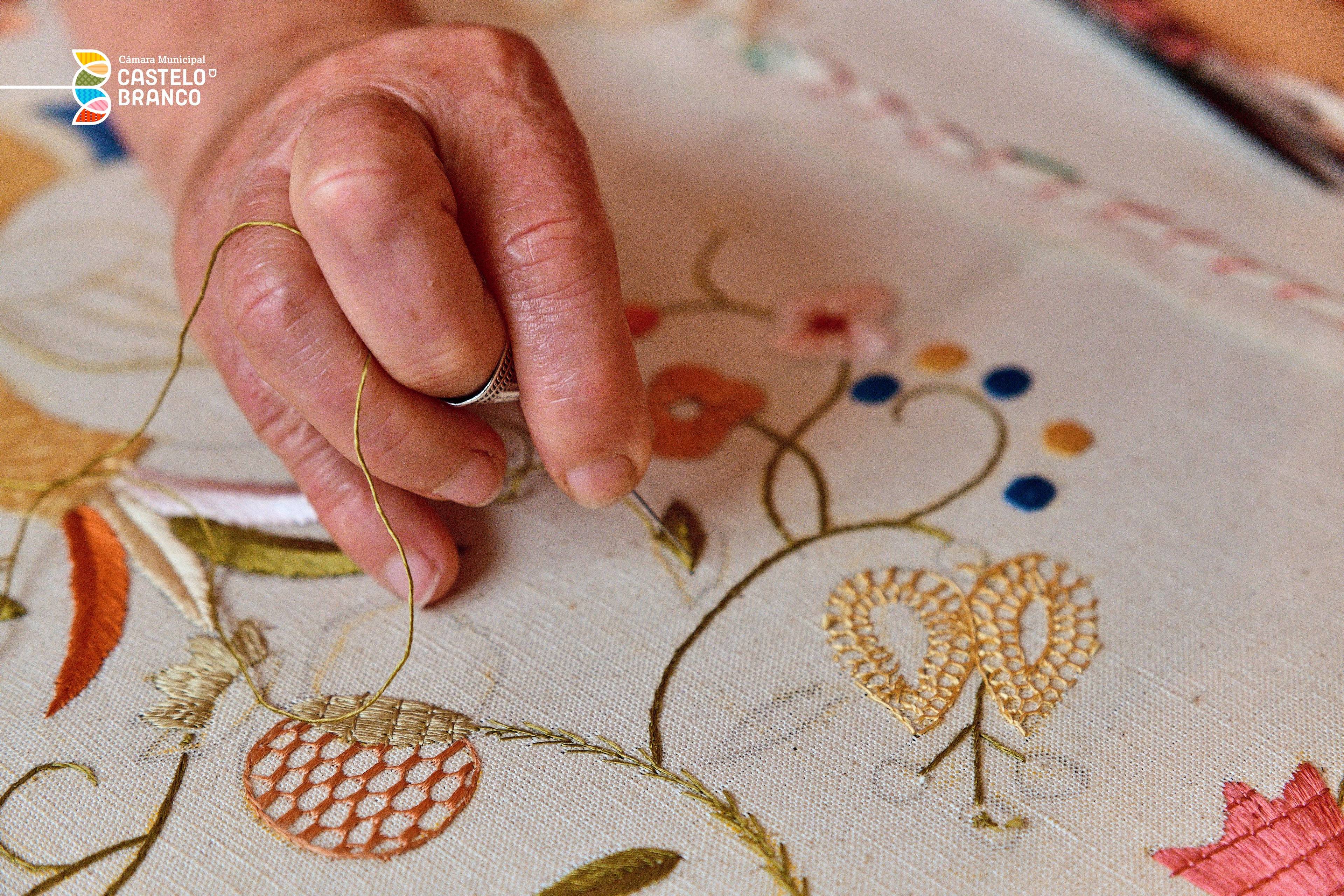
Probably originating in the 17th century, it was only at the end of the 19th century and into the early 20th that it came to be known as Castelo Branco Embroidery, as it was here that production continued and took on its own distinctive characteristics. The result of a long evolutionary process, both in terms of its timeline and geographical positioning, Castelo Branco Embroidery is characterised by its decorative motifs, techniques, raw materials and colour palette. Characterised by the use of the couched Burden stitch, Castelo Branco embroidery brings together influences from Chinese and Indian textile production, combined with the tradition of European and Portuguese decorative arts.
The term ‘Castelo Branco Embroidery’ was first used in writing in 1891, in an article in the newspaper Correio da Beira; since then, this type of embroidery has been associated with the city of Castelo Branco and with bedspreads, the production and sale of which from this region are believed to have been a thriving activity as early as the 17th century.
Originally, and up until the mid-19th century, these pieces were produced in workshops with the assistance of professional designers ('debuxadores'), which suggests the existence of a vast market for this craft.
In the second half of the 19th century and throughout the 20th century, production on a non-workshop scale became widespread, although there is no evidence to suggest that it was carried out exclusively in the home. At the same time, industrial-scale production began in the 20th century, combining traditional craftsmanship with mechanised methods. Until the 1920s, embroidery was a dispersed practice, rarely associated with the town of Castelo Branco. The arrival of this specific type of work in Castelo Branco is attributed to Piedade Mendes, a native of the parish of Estreito in the municipality of Oleiros, who, during her visits to the town, would meet with a group of local women, whom she taught. In the 1940s and 1950s, the domestic practice of embroidery in Castelo Branco took on a new dimension, moving from small-scale domestic production to workshop-based units. The Oficina da Mocidade Portuguesa Feminina and the Casa Mãe de Elísio José de Sousa were particularly notable in this context. While Elísio José de Sousa set up a ‘workshop-factory’ that combined modern technology with so-called traditional embroidery, the Mocidade Portuguesa Feminina carried on with the idea of traditional embroidery produced by hand, within a women’s context.
During the Estado Novo regime, against a backdrop of the rise of Beira regionalism, attempts were made to revive the production of Castelo Branco embroidery. This process was led by Sales Viana, Luís Chaves and Father Ribeiro Cardoso, who established the official narrative framing and explaining Castelo Branco embroidery – a narrative oft repeated to this day – and which influenced the major changes the embroidery has undergone this century in terms of composition, technique, raw materials and colour.
In 1976, following the dissolution of the Mocidade Portuguesa Feminina, the Regional Embroidery Workshop and School was established at the Francisco Tavares Proença Júnior Museum, a production and research centre dedicated to Castelo Branco embroidery. This Workshop-School was responsible for cataloguing all the stitches used in Castelo Branco Embroidery, based on the bedspreads in the Museum’s collection and on pieces produced for sale. The stitches catalogued are those used today in the work carried out by embroiderers, totalling 48 stitches.
Despite the combination of a wide variety of stitches that can also be observed in other types of embroidery found in the country, one of the distinctive features of Castelo Branco embroidery is the preferential and predominant use of the couched Burden stitch, also known as the Castelo Branco stitch. Its name derives from the use of low-twist silk thread, the main characteristic of which is the filling of large areas of fabric using a technique that economises on thread.
The embroidered designs have their own symbolism, suggesting a visual language influenced by the East, such as the Tree of Life, birds, carnations, roses, lilies, pomegranates and hearts.
The materials generally used in Castelo Branco embroidery are linen and natural silk. Linen is used for the base fabric, while silk thread is used for the embroidery.
Part of the embroidery process involves the use of a horizontal embroidery frame, a simple structure consisting of perforated slats fitted together and supported by two legs, which allows the linen to be stretched taut, providing a comfortable working area for the embroiderer. To create the fringes by hand, which are applied to some pieces, the embroiderer uses a fringe loom, a simple wooden tool.
In addition to bedspreads, which are considered the most iconic and valuable product of Castelo Branco embroidery, items such as wall hangings, cushions, doilies and clothing are also produced today.
Castelo Branco embroidery is now one of the traditional national crafts listed in the National Register of Certified Traditional Handicrafts and forms an important part of the region’s cultural identity; some of its motifs can be seen in public spaces in the town of Castelo Branco, such as pavements, gardens and roundabouts; and in the decoration of items used for festive and symbolic occasions, such as wedding and christening dresses.
Text provided by the Municipal Council of Castelo Branco.
Bibliography
- Câmara Municipal de Castelo Branco, coord. (2015). Bordado de Castelo Branco. Castelo Branco: Câmara Municipal de Castelo Branco
- PIRES, Ana; RAMOS, Graça, coord. (2022). Caderno de especificações para a certificação do bordado de Castelo Branco. Castelo Branco : Câmara Municipal de Castelo Branco, 3.ª edição
gallery
Arts
Learn more
Itinerary: Silk Thread