map of Caldas da Rainha Embroidery
Caldas da Rainha Embroidery
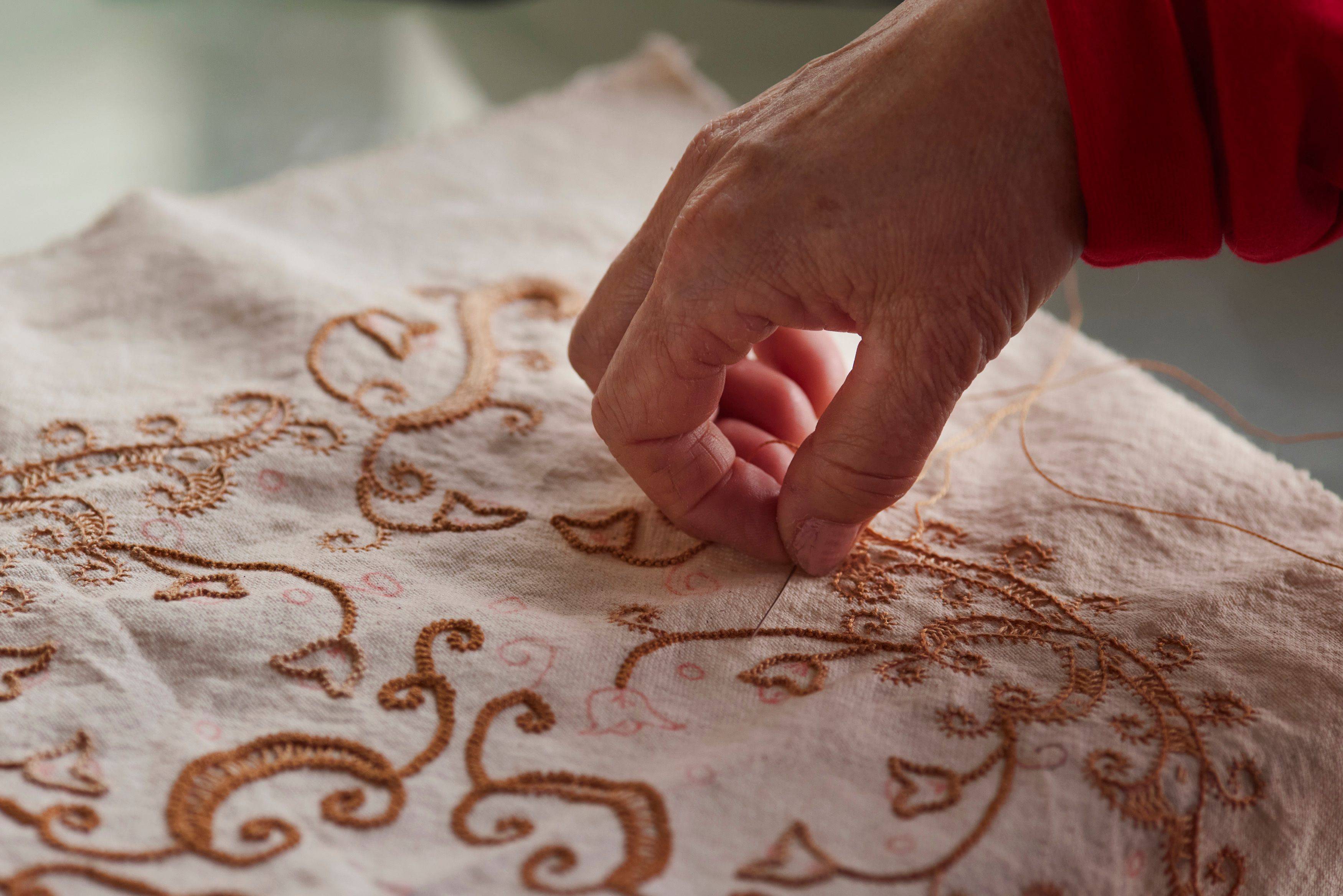
Caldas da Rainha embroidery is one of the most recognisable forms of Portuguese embroidery. It is an extremely original, almost abstract style of embroidery, devoid of any flowers or plant motifs. It is created using narrow, wavy stitches that form scrolls, which run alongside one another, cross over or fork, giving rise to small coils.
Added to the unusual nature of its design – so different from anything else found in Portuguese embroidery as a whole – is the fact that it is embroidered in three shades of brown, ranging from golden brown to a honey hue, creating a colour palette that is also quite unusual, with a result that even led a columnist to write in the Gazeta das Caldas in 1927 that the embroidered tablecloths of Caldas da Rainha resembled ‘plates of rice pudding garnished with cinnamon’.
The seminal article on Caldas da Rainha embroidery published in the Gazeta das Caldas on 25 September 1927 was entitled ‘Os bordados de D. Maria Margarida dos Santos. Uma empresa de Arte’ (The embroidery of D. Maria Margarida dos Santos. An Artistic Endeavour). That article reported on a section of the 5th Caldas da Rainha Exhibition, comprising a collection of pieces embroidered by that lady and by the ‘pleiad of embroiderers she has so skilfully chosen’.
Margarida Santos, who was skilled in various types of embroidery – as can be seen from the 1927 news report – came across an old embroidered cloth featuring the colours of the threads that were still being sold outside the Thermal Hospital as late as the end of the 19th century and decided to reproduce it and apply its decorative motif to other pieces. This recreation gave rise to an embroidery in the image and likeness of that old embroidered piece, which was a corner of a very old altar cloth kept in the Igreja do Pópulo and executed with threads that reflected the colours traditionally sold in Caldas da Rainha.
Clementina Carneiro de Moura, who later worked alongside Margarida Franco dos Santos to further develop designs for Caldas da Rainha embroidery (there are still some people who own pieces by her), also ensured that this design was included in the catalogue of Portuguese embroidery patterns that the students on the Women’s Training Course at the Commercial and Industrial Schools were required to learn.
There has always been a temptation to link this embroidery to Queen Leonor, founder of the town of Caldas da Rainha and one of the most notable of Portugal’s queens. However, what is actually known about non-workshop embroidery from the late 15th and early 16th centuries (Queen Leonor lived between 1458 and 1525) bears no resemblance to what is now known as Caldas da Rainha Embroidery. The style of Caldas da Rainha Embroidery, as it appears to us today, clearly harks back to embroidery produced throughout southern Europe in the early 17th century.
There is thus no factual evidence to link this embroidery to the direct influence of Queen Leonor; consequently, any association of ‘Caldas da Rainha Embroidery’ with the city’s founder is rooted in sentiment and legend.
Scrolls and straight lines form the defining characteristic of Caldas da Rainha embroidery, defining and structuring the various patterns, within which other motifs may appear, such as the ‘carinhas' (lit. 'little faces’) or the symbols of Queen Leonor, such as the crown, the prawn basket, or the pelican.
'Aranhas' (star-shaped elements), little arches and small birds complete the list of motifs, and it is surprising to see how the interplay of these elements can produce such diverse images. Indeed, some people now speak of ‘traditional embroidery’ to refer to the older style, based entirely on scrolls and straight lines, and ‘modern’ embroidery, with more figurative motifs, featuring a great deal of 'ponto de formiga dupla' (double running stitch) in place of the 'ponto pé de galo interrompido' (feather twig stitch).
In addition to the stitches already mentioned, one can also see chain stitch, double running stitch, eyelets and stitches forming stars, sheaves and other forms.
Nowadays, the embroidery is richer, heavier and, it must be said, represents a marked departure from its founding tradition, as the replacement of the feather twig stitch with the double running stitch compromises its original lightness and elegance.
The ongoing certification process may encourage critical reflection on this form of embroidery, particularly with a view to developing a strategy for its revival.
A very special thank you to Teresa Perdigão for her unparalleled support, and to Joana Beato Ribeiro, Principelina Loução and Ana Maria Pereira, embroiderers and enthusiastic guardians of Caldas da Rainha embroidery, who have helped me greatly with this work.
Text by Ana Pires, a specialist in Portuguese textiles.
Bibliography
- CALVET de MAGALHÃES, M. M. (1956). Bordados e Rendas de Portugal. Coleção Educativa, Série N, º 10, p. 129-130
- JOAQUIM, Teresa (1997). Menina e Moça. A Construção Social da Feminilidade. Coleção Margens. Lisboa: Fim de Século
- MOURA, Maria Clementina C. de (1961). O Desenho e as Oficinas no Curso da Formação Feminina. In Escolas Técnicas. Boletim da Acão Educativa, N.º 29. Direção Geral do Ensino Técnico Profissional/ Ministério da Educação Nacional
- MOURA, Maria Clementina C. de (1968). Tapeçarias e Bordados. In LIMA, Fernando C. P. de (Dir.) A Arte Popular em Portugal, vol. III, Lisboa: Editorial Verbo
- PAULO Jorge de S. (1928) História da Rainha D. Leonor e da fundação do hospital das Caldas. Lisboa: Empresa Nacional de Publicidade
- TAVARES, Mário (1999). O Bordado das Caldas ou Bordado da Rainha D. Leonor (apoio técnico e ilustrações de Idalina Lameiras). Coleção Testemunhos, N.º 3. Caldas da Rainha: PH – Património Histórico
- Os bordados de D. Margarida Santos. Uma empresa de arte. Gazeta das Caldas, N.º 88, 25 de setembro de 1927