map of Cork
Cork
Common name(s) in Portugal
Sobreiro, Sobreira, Choupo, Chaparro
Scientific name
Quercus suber L.
Distribution across the national territory
It is the dominant species in cork oak forests and cork oak woodlands, but is also found in other types of woodland and forests. Although it is found throughout the country, it is most prevalent in the south.
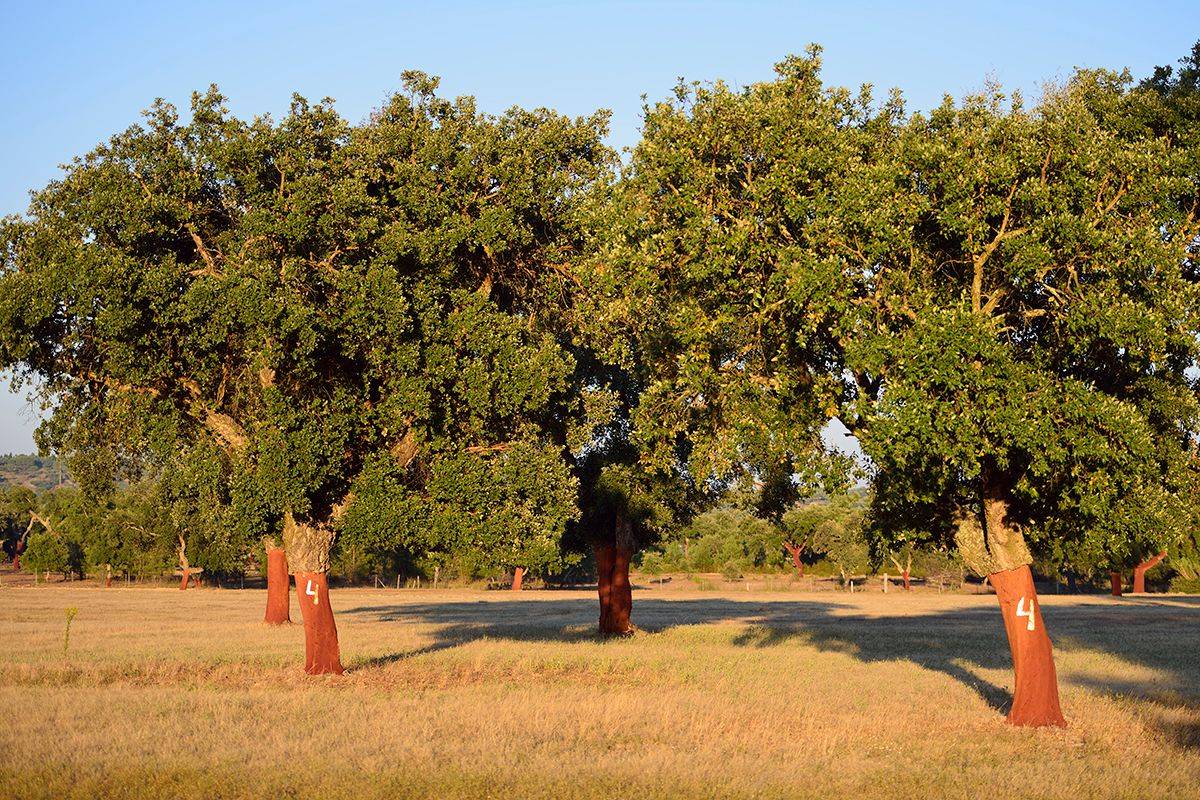
Cork is the bark of the cork oak (Quercus suber L.), a tree also known as the sobro or chaparro in Portugal, one of several species of oak that form part of the country’s native forests.
The cork oak is an evergreen tree characterised by slow growth and great longevity; it can live for over two centuries and reach a height of twenty-five metres. It takes around twenty-five years before cork can be harvested from a tree for the first time; subsequent harvests are carried out manually every nine years, without causing any harm to the tree. Each year, a new layer of cork forms, overlapping the previous ones.
The first harvest yields virgin cork, which is of lower quality due to its hard and irregular texture, giving it a lower economic value. It can be used in the production of black agglomerate, a solid and resistant material obtained by compacting it at high temperatures, around 300°C. Second-harvest cork, resulting from the harvest after nine years, is more uniform than virgin cork, but still does not possess the ideal quality for the manufacture of cork stoppers. Amadia cork, harvested when the tree is around forty years old, possesses the characteristics required for the production of high-quality cork stoppers. However, only around 25 per cent of amadia cork is used for this purpose, with the remainder being reused to produce granules, as is the case with virgin and second-harvest cork.
When viewed under a microscope, cork has a honeycomb-like structure, with prismatic cells that are predominantly pentagonal or hexagonal. Composed mainly of suberin, it also contains lignin, polysaccharides, tannins and ceroids. Its properties make it ideal for a variety of applications, including as thermal and acoustic insulation. It is resistant to high temperatures and possesses excellent elasticity, lightness, water resistance and hygienic properties. It is an extremely versatile raw material, widely used both in the wine industry (for corks) and in the construction industry, and has since expanded into footwear, fashion, interior design and other everyday consumer goods. Its traditional uses include the manufacture of 'cocho' bowls, lunch-boxes, footstools and beehives.
Portugal has the world’s highest concentration of cork oaks, particularly in the south of the country, where the agro-sylvopastoral landscape known as the ‘montado’ predominates. This ecosystem is of great importance in the prevention of forest fires, due to the coexistence with agricultural crops and its resilience to fire. Furthermore, it is home to a wide variety of animal species and plays a crucial role in the local economy through the harvesting of acorns, cork and the use of pastures. Portugal is notably the world’s leading exporter of cork, which is why the cork oak was declared the national tree by Resolution No. 15/2012 of the Assembly of the Republic.
gallery
Learn more
Itinerary: The Age of Cork