map of Osier Wickerwork
Osier Wickerwork
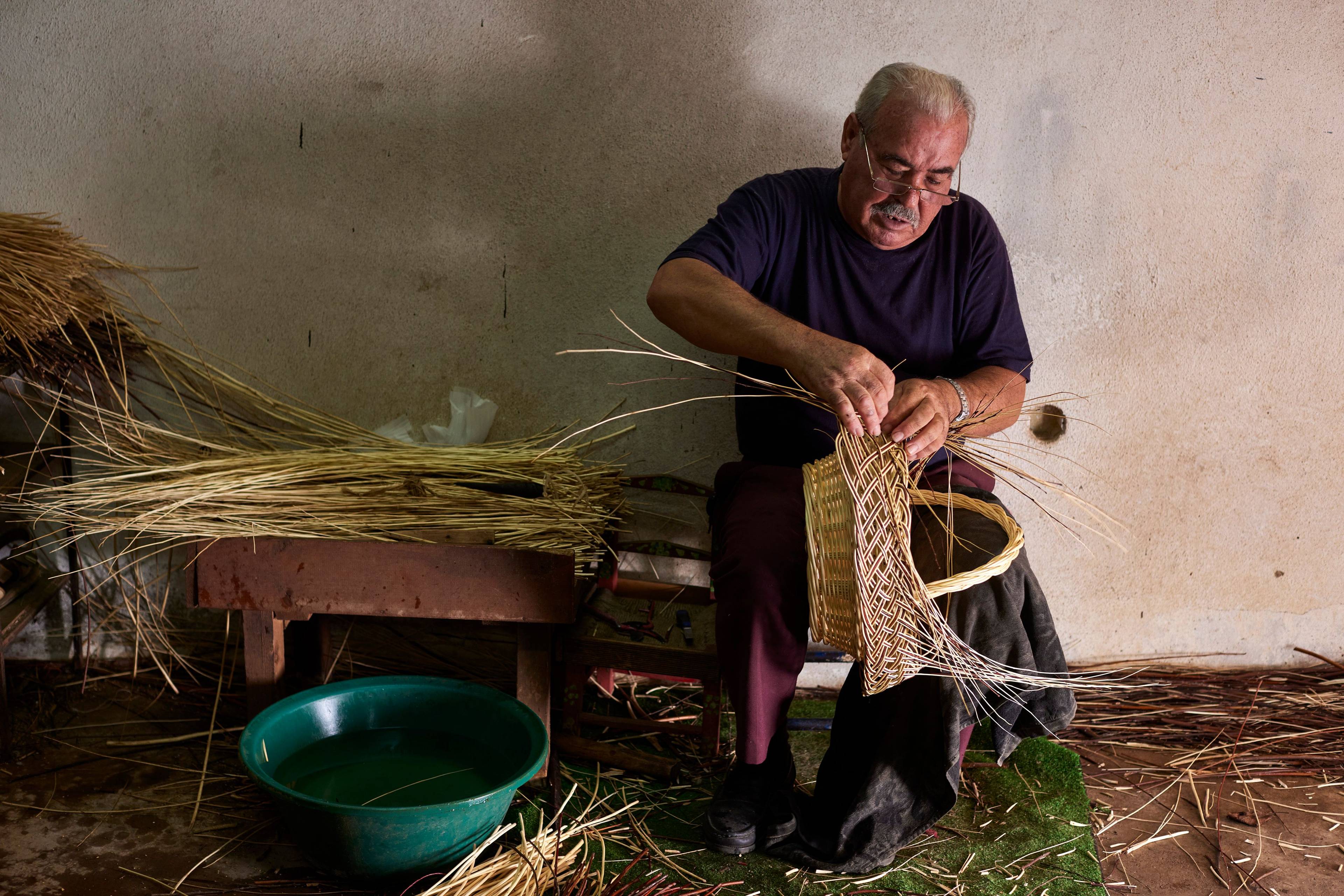
Osier wickerwork is one of the most widespread arts and crafts traditions in Portugal. The main centres of osier wickerwork are Gonçalo, in the municipality of Guarda, and Camacha, on the island of Madeira. However, the presence of the osier or willow tree across almost the entire country has led to the spread of this craft across many regions, from north to south, as well as in the Azores and Madeira archipelago.
Baskets – the primary product of this craft – reveal a great deal about the activities and economy of their makers, their users and the regions where they are found. The list of names given to different baskets, based on their shape or function, is long and varies across the whole country: cabaz, alcofa, mala, poceiro, giga, cofinho, ceira, açafate, amieira, canastra, gagreleire, condessa – to speak only of those for domestic use. Owing to its sturdiness, osier wickerwork has played a role in many of the most demanding rural activities, notably in the form of the cesto vindimo (grape-harvesting basket) in Madeira.
‘Osier wickerwork is classified into three categories: light work, medium work, and furniture. Baskets of various shapes for domestic use and those used in agricultural tasks, such as the cesto vindimo, fall into the second category.’ (DRCM).
The wide variety of shapes and functions of the baskets stems primarily from the creativity of the craftspeople themselves, as the techniques and tools used have changed little over time. Over the years, with the introduction of new products and materials, baskets have gradually shed their original function as a means for transporting goods and taken on a more domestic and decorative role (LIMA, 1993).
Covering glass carboys and bottles with wicker for added protection during transport and use, or for decorative purposes, was another speciality of the wickerwork artisans. ‘Using similar techniques and the same materials and tools, craftspeople cover glass bottles, chair seats and various items of furniture with their wickerwork. To do this, they create a simple wooden frame, which is then lined and decorated with wickerwork.’ (CADA).
Furniture is another application for this plant fibre. During the 20th century, chairs were among the most widely sold and sought-after wickerwork products, and remain a common sight in public spaces and homes to this day. Their names vary according to their geographic origin, shape and function, including the cadeira de bordadeira (embroiderer’s chair) from Madeira, and the cadeira de concha (shell chair). Wicker furniture was a particularly significant industry on the island of Madeira, with some of Portugal’s most widespread models – such as single- or two-seater armchairs, low tables, standard tables, shelving units and chests – likely to have originated there.

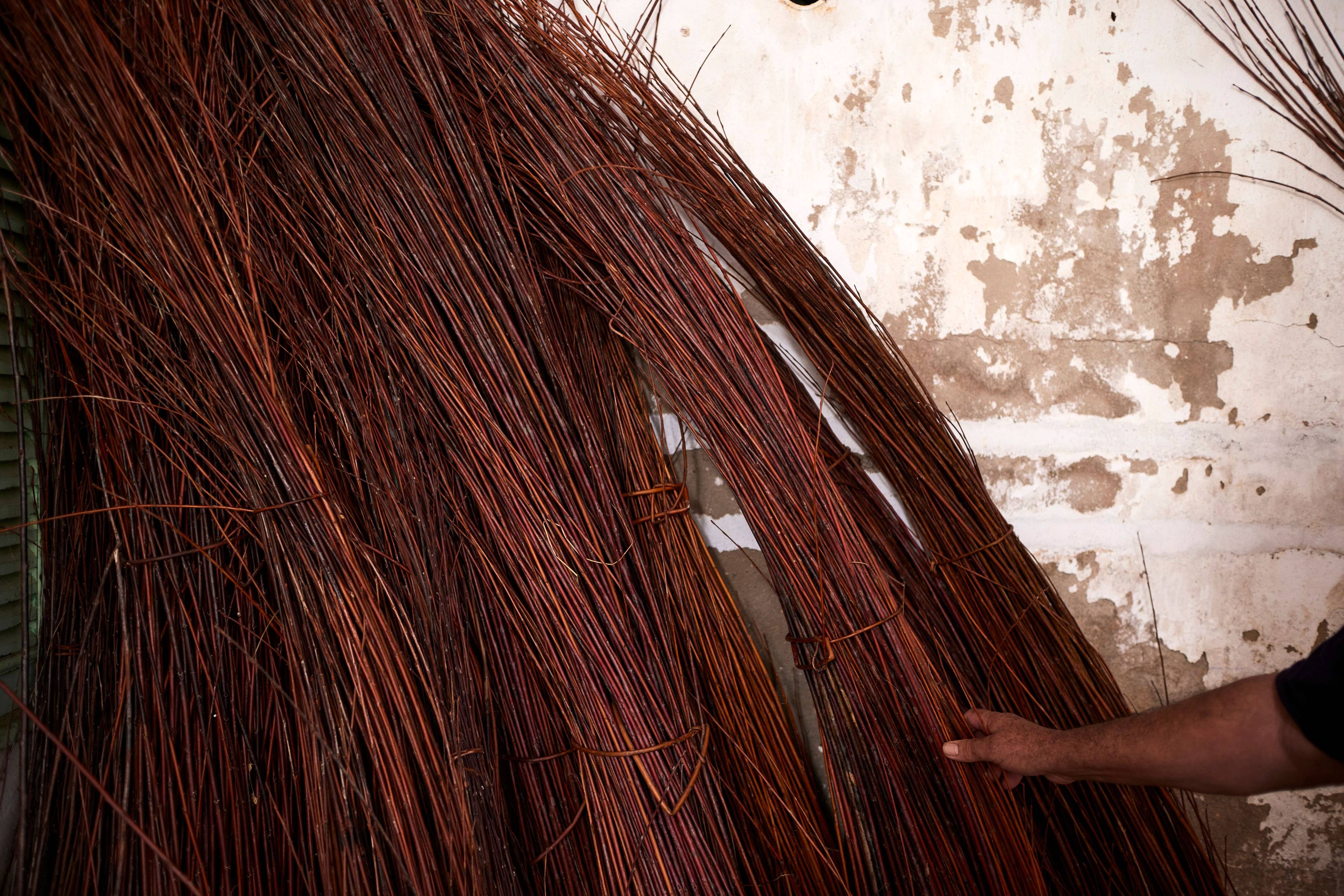
Weaving wicker strands requires the material to be pliable. For this purpose, the wicker is stored after being boiled and dried, and then soaked again shortly before use to soften it and make handling and weaving easier.
Wicker rods can be worked with whole or split. Using a rachadeira (splitting tool), a single rod can be cleft lengthwise into three or four strips, known as liaças, which are then passed through a fiadeira (sizer) to ensure uniform thickness.
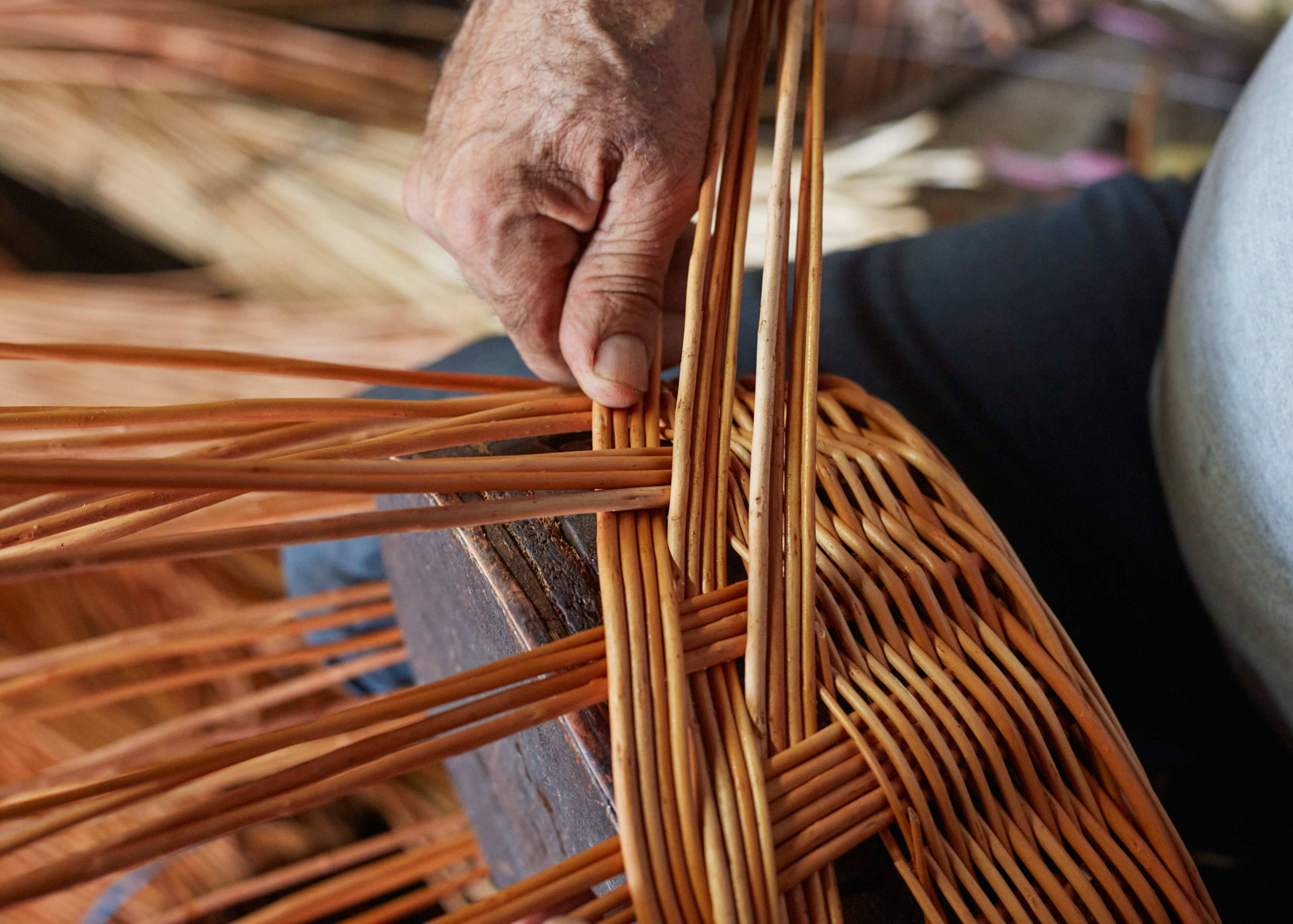
Baskets are woven from the base by crossing the wicker rods (known as ástias on Madeira), which determine the basket’s shape and size. Once the base has been woven, the side sections are raised and shaped either by hand or using wooden moulds, which keep the dimensions consistent and allow various basket types to be reproduced to standard designs (PIRES, 2013).
Tools used include an awl, a hammer, nails of various sizes, pruning shears, a straightening tool and a splitting tool.
The finished pieces feature different types of finishes and decorative effects, depending on their place of origin, production method and the individual artisan’s taste, Different species of wicker and the treatment applied to the rods – which can be used with or without their bark, boiled or burnt, varnished or unvarnished – result in distinct colours, ranging from pale yellow and green, grey and reddish-brown. These colours are sometimes combined within a single piece to create decorative effects.
Wicker craftsmanship continues to thrive from north to south on the Portuguese mainland, encompassing both basketry and furniture making. The districts of Braga (especially Barcelos) and Guarda account for a large share of production, with Gonçalo the country’s principal centre. Production also takes place in the districts of Évora (at Montemor-o-Novo) and Faro (Monchique and Castro Marim), particularly in the form of basketry.
Although the tradition remains alive on the island of Madeira, a lack of market demand has led to a sharp decline in wickerwork. The Parque Temático da Madeira in Camacha has a workshop where an artisan demonstrates the entire process, from treating the wicker to producing the finished items, which are then sold at the park (PERDIGÃO, 2013).
In the Azores, ‘despite going through a difficult period, wickerwork remains a hallmark of the archipelago’s tradition and culture. Osier willow, which once grew abundantly, has been reintroduced into certain areas, not only for environmental reasons – to protect the banks of streams from erosion – but also for social and economic purposes, to provide raw materials for local crafts.’ (CADA). Wickerwork is produced on the islands of Faial, Santa Maria, Terceira and São Miguel, with a total of nine artisans engaged in activities such as basketry and the weaving of wicker furniture.
Bibliography
- BRANCO, Conceição; SIMÃO, Jorge (1997) Modos de Fazer. Guia do artesanato Algarvio. Faro: Região de Turismo do Algarve.
- Cestaria. In Centro de Artesanato e Design dos Açores (CADA). http://artesanato.azores.gov.pt/artesanato/fibras-vegetais/cestaria-2/ [Consultado em 3 de Novembro de 2022]
- Empalhamento. In Centro de Artesanato e Design dos Açores (CADA).. http://artesanato.azores.gov.pt/artesanato/fibras-vegetais/empalhamento/ [Consultado em 3 de Novembro de 2022]
- KUONI, Bignia (2003) Cestería tradicional ibérica. Barcelona: Ediciones del Serbal.
- LIMA, Rui de Abreu de (1993) Cestaria tradicional portuguesa. Feira Internacional de Artesanato. Lisboa: IEFP – Instituto do Emprego e Formação Profissional.
- O Cesto Vindimo. In Direção Regional de Cultura da Madeira (DRCM). https://cultura.madeira.gov.pt/obras-e-artistas1/518-o-%E2%80%9Ccesto-vindimo%E2%80%9D.html [Consultado em 3 de Novembro de 2022]
- PERDIGÃO, Teresa; CALVET, Nuno (2001) Tesouros do Artesanato Português. Volume I: Madeiras, Fibras Vegetais e Materiais Afins. Lisboa: Editorial Verbo.
- PERDIGÃO, Teresa (2013) “Vimes da Madeira” in Idades Entrelaçadas. Formas e memórias das artes de trabalhar fibras vegetais. Lisboa: IEFP – Instituto do Emprego e Formação Profissional.