map of Lorvão Carved Toothpicks
Lorvão Carved Toothpicks
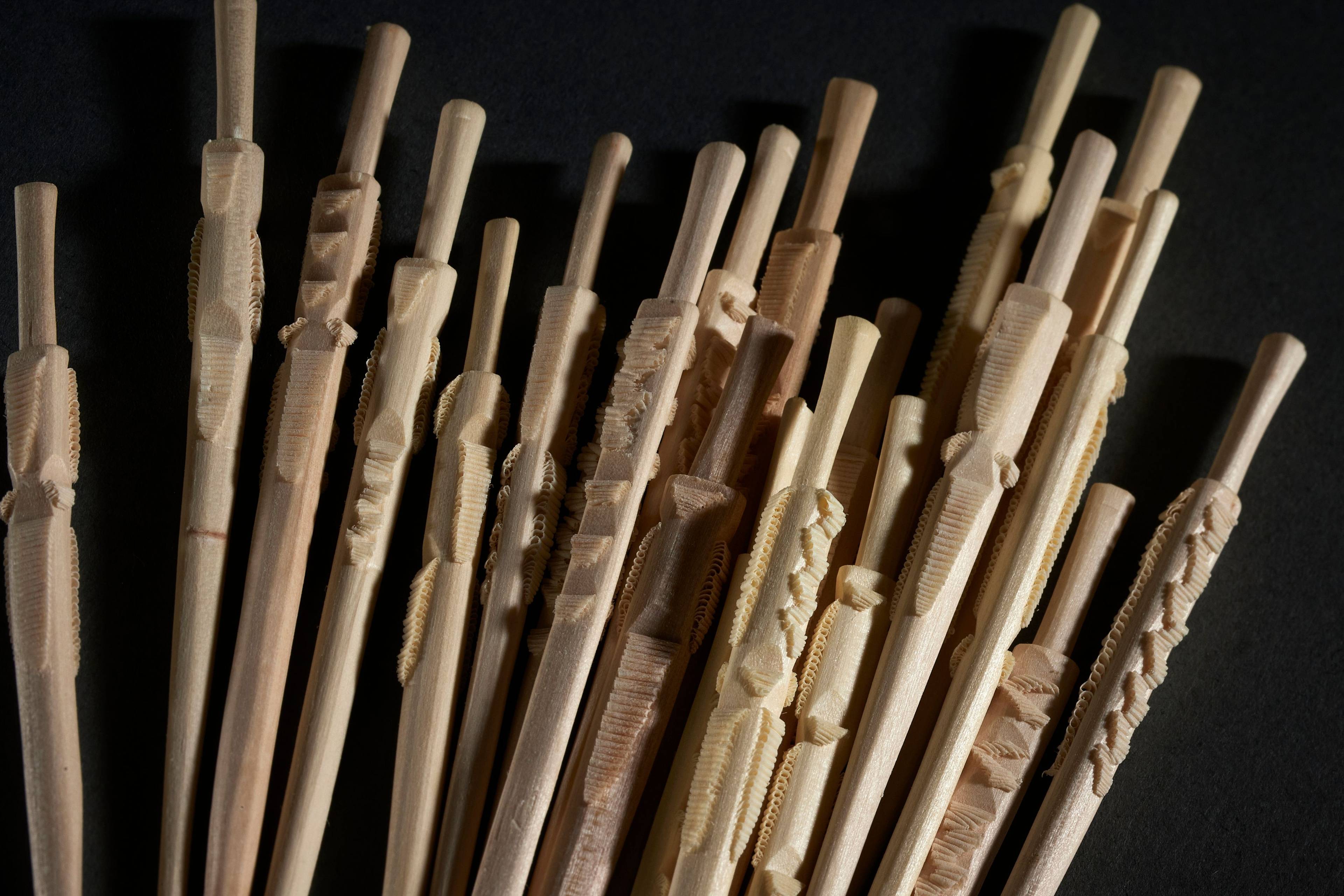
Closely linked to the manufacturing industry and playing a significant role in the local economy, the toothpick production process brings together two types of traditional knowledge. The first is the ethnobotanical knowledge of native vegetation and specific plant species, particularly willow and poplar, and procedures for selecting, felling and preparing the wood for toothpick making – including debarking and drying in the sun or in ovens. Second is the technical knowledge and skill involved in slicing the wood using simple tools. Here, the craftsperson’s dexterity – learned and honed within the family setting from childhood – is key.
Toothpick making is a pre-industrial manufacturing activity found in several parishes of Penacova (Figueira de Lorvão, Lorvão and Penacova). It makes use of native tree species that grow along the banks of the River Mondego – particularly willow and poplar – and has long held a symbolic significance both regionally and nationally. It is worth highlighting the economic significance of this craft for the local communities, with roots dating back to the 18th century. The historical evidence for this owes much to the records of the Monastery of Lorvão. Unable or unwilling to explain the expenditure of 600,000 réis, the nuns administering the Monastery attributed the cost to the use of toothpicks – a detail interpreted as evidence of the local prominence of the toothpick industry at that time, as the nuns used this explanation to mask other expenses.
According to tradition, toothpick making originated at the Monastery of Lorvão and later spread to neighbouring villages, some located in the municipalities of Vila Nova de Poiares and Coimbra, due to the movement of people away from Lorvão as a result of marriage, economic necessity or other factors. Besides the Monastery’s influence in popularising toothpicks, the area is also abundant in white willow and poplar trees. As a region with limited agricultural resources – where men earned a livelihood from hoe-based labour, often working on others’ farms – Lorvão provided an ideal setting for a cottage industry like toothpick making. This allowed the local people to make productive use of their spare time and contribute to the household, with children, women, the elderly and adult men all pitching in. Although the profits derived from making and packaging the toothpicks were low, they were a welcome supplement to household budgets. People could fit this craft around their other commitments, which varied in intensity throughout the year.
In 1898, an export agency for toothpicks opened in Lorvão, serving markets in European countries such as Spain and the United Kingdom, the former Portuguese overseas territories and the Americas. Portuguese toothpicks began appearing in Panama, Brazil and Mexico (‘Indústria dos Palitos’, O Defensor do Povo, No. 40, Coimbra, 4 December 1892). This small-scale industry was promoted in various ways throughout the 19th and 20th centuries. These included showcasing the craft at multiple events, most notably the district exhibitions of 1869 and 1884 in Coimbra; national exhibitions such as the Portuguese Industry Exhibition in Lisbon in 1888 (where seven toothpick exhibitors received awards – three bronze medals and four honourable mentions); and the Crystal Palace Exhibition in Porto in 1891. Toothpicks also featured at international events, such as the Paris Expositions in 1900 and 1910, the Argentine Exhibition in 1910, the Panama-Pacific International Exhibition in 1915, the Rio de Janeiro Exposition in 1922 commemorating the centenary of Brazilian independence, and various showcases in London. On these occasions, the toothpicks won awards not only for the skill and perfection with which the artisans demonstrated their craft, but also ‘for the charm of the communities they represented’.

The actual production of the toothpicks – the slicing of the wood – is usually carried out at home. Neighbours often gather on their doorsteps, weather permitting, to perform this meticulous work under natural light. There are several stages to the craft: selecting, felling and cutting willow or poplar wood and preparing it at the sawmill; drying and processing the wood; shaping the wood into individual toothpicks; counting the toothpicks; and packaging.
The tools used include a workbench, a standard basket or condessa (a specific type of basket), a coira and coiro (protective leather pads), a paring tool, a blunt-tipped billhook or pruning knife, a pocket knife or English-style knife, a sharpening stone and a piteira (a holder).
Currently, the best-known toothpicks are flat-ended, double-pointed floral or eyelash styles. In the past, other varieties were also produced in Lorvão, such as cut flat at both ends, serrated, tapered or extra-large versions.

In Penacova, toothpick making has become an iconic feature of the local traditional culture. This is reflected in the fact that in recent decades two folk dance groups from the parish of Lorvão – the Grupo Etnográfico de Lorvão and the Rancho Folclórico ‘As Paliteiras de Chelo’ – have focused on re-enacting the toothpick-making process during their performances.
Currently, toothpick packaging in the parish of Lorvão alone generates approximately 4 million euros in revenue. In the municipality of Penacova, more than 1,000 people aged over 40 still know how to make toothpicks. However, they produce only small quantities, as there are few buyers, while sales to large retail outlets are prohibited for hygiene reasons. Current Portuguese legislation does not permit the sale of handmade toothpicks in shops. Nevertheless, some restaurants across the country still opt to proffer this type of toothpick alongside certain delicacies, particularly starters and francesinhas (popular meat-laden sandwiches from Porto). Virtually the entire domestic market is supplied by toothpicks packaged in Lorvão. The machines in Lorvão’s factories no longer produce toothpicks; although a few toothpick makers are hanging on, globalisation has dictated that the local speciality is now toothpick packaging. Since it is cheaper to import the raw material in a pre-prepared state, boxes of toothpicks are now shipped from China, inspected in Lorvão for quality control and – if they meet standards – pass through the hands of workers at various factories (or women in Lorvão working from home to supplement their monthly income), who wrap them in paper or place them in boxes or toothpick holders. Lorvão was once dubbed Portugal’s ‘toothpick capital’ by Leite de Vasconcelos, but it has since lost its monopoly on toothpick making.

Logs are felled in December and January, then sawn, split, cleaned and stripped of bark by the loggers. In the past, the loggers were also responsible for selecting the wood to be felled. Today, this sorting is often done by the people who make the toothpicks. The logs are then split by two men working together. Each holds the log securely and rests the axe on the top of the log, striking it with a mallet to split the log into two halves. The wood is debarked and cleaned using a billhook, after which the central core and any knotty sections are cut away. The ‘halves’ of the wood are then split again and tossed onto the ground. When purchasing wood, craftspeople select the pieces they want and tie them into bundles known as molhadas – sets of sticks or rods that have been cleaned, stripped of bark and bound with wire – in the desired quantity. At home, the wood is laid out to dry in the sun during March and April, either in a straight line against a wall or stacked in castelos (castles). The latter method is known as encasar and involves arranging the sticks in casas (houses) by crossing them two by two, parallel to each other, to form a square stack. After the wood has been dried in the sun to remove any moisture, it undergoes a final drying process in a household or communal oven usually used for making cornbread. When the oven is still hot from baking a batch of bread, the wood pieces are placed inside to de-soften the material. This tempers the wood according to its intended use: hard or soft, depending on whether it is to be made into a standard toothpick or a carved decorative one. Generally speaking, wood intended for floral toothpicks is dried only in the sun. If it gets too hot, however, it may need to be moistened again with a little water before working with it. Once the wood is completely dry, it is split with a billhook (a cutting tool with a curved blade ending in a serrated edge) until there are small pieces that can be shaped with a pocket knife. These pieces are called nacas (slices). The craftsperson continues to split the wood, producing flat strips about two centimetres wide, which are then split lengthwise down to near the base. Each of the resulting rachas (strips) is called a coto (stump); the more of these there are, the greater the number of toothpicks that can be made. Typically, there are four or five cotos per split piece. This stage is performed by older artisans, as it requires great skill. Traditionally, young female toothpick makers do not usually begin splitting the wood until after they get married. Carrying out the whole process alone has never been the done thing; experienced craftspeople pitch in to assist with the wood-splitting stage. In Lorvão, it was common for women to work half-days splitting wood to earn a little extra money or food. Wood destined for floral toothpicks is split using a pocket knife until the resulting strips are deemed suitable for toothpick making. However, the technique of splitting the wood with a knife differs depending on the type of toothpick: the floral style requires rounded strips, whereas eyelash-style toothpicks call for flatter pieces.
Starting with pieces of wood – known as pegadas or cotos – the toothpick maker whittles the sticks until they are slightly rounded and slightly longer than the finished toothpick, with one end sharpened. Next, the pieces are split from the racha (or pegada) and cut into specific shapes: pá (flat-tipped or spade-like), palitos de dois bicos (double-pointed) or croques (cut flat at both ends). This yields an initial batch of picks, which are gathered in the palm of the hand holding the racha. This process is then repeated successively until the entire racha has been split into toothpicks. In the case of palitos de flor (floral toothpicks), the artisan gradually shapes the wood so that it begins to take on a form similar to that of a standard toothpick. In this case, only a single toothpick is produced from each piece of worked wood. The finishing process begins with luxar – running the edge or back of a knife blade repeatedly over the wood until it acquires a certain sheen. Then the artisan begins carving the decorative elements – the flor (flower) or pestana (eyelash) pattern. For the flor type, the artisan uses a knife to lift small wood shavings that curl back on themselves, forming a varied series of patterns. She takes great care not to repeat the same motif on each section of the toothpick. She may make small guide marks on the wood using a gauge to mark out the area to be decorated. For the pestana type, the shavings are created first on one side and then on the other. A well-worn knife must be used to create both types of design. Once the decoration is complete, the head of the toothpick is smoothed to give it a sheen, and then the toothpick is severed from the rest of the wood.
Once finished, the toothpicks are counted into pares (groups of four) and tied into maços (bundles). A bundle of pá e bico (flat-and-pointed) toothpicks contains 30 pares (30 x 4 = 120 toothpicks), while primeira (premium) bundles contain 50 pares (50 x 4 = 200). The bundles are then broken up and the toothpicks packaged for retail sale. The packaging is also worthy of note, as toothpicks need to be presented in a specific way, while maintaining ‘the utmost hygiene, to prevent viruses from being passed on by toothpicks exposed to dust and everyone’s fingers’. Toothpicks intended for personal use are simply tied with string, known as guita, and placed in a toothpick holder. Toothpicks made for sale are packaged in carteiras (cardboard boxes), cartuchos (small packets containing three or seven-and-a-half pares wrapped in tissue paper) or tubos (prism-shaped cardboard containers with a hole at one end for dispensing the toothpicks). For toothpicks with a floral design, the packers create colourful conical wrappers made of paper, into which only the tips of the toothpicks are inserted. Each of these bundles contains a set of toothpicks that typically feature a range of different designs. These are then grouped into sets of four packs, with two placed one way and two the other, to create a total of one hundred toothpicks. Eyelash-style toothpicks are packaged similarly to the others, but with a different internal configuration to prevent damage. Each set of toothpicks is divided into two packets – one containing twelve and the other thirteen – so that each set of one hundred comprises eight small packets.
Text by Paula Silva
Author of the documentation prepared for the classification process of the Lorvão toothpick-making tradition as Intangible Cultural Heritage.
Bibliography
- BORGES, Nelson Correia (1992) A arte monástica em Lorvão, sombras e realidades, Coimbra: Fundação Calouste Gulbenkian, pág. 38-39
- COLAÇO, Magalhães (1913) “Palitos de Lorvão”, in Illustração Portugueza, 364, Lisboa, pág. 170-173
- GOUVEIA, Henrique Coutinho (1981) Palitos de pá e bico (exposição itinerante), Coimbra, Museu e Laboratório Antropológico da Universidade de Coimbra
- Relatório dos serviços da 2.ª Circunscrição Industrial nos anos de 1916 a 1920, 1923, in Boletim do trabalho industrial, n.º 119, pág. 17-19
- SECO, António Henriques (1853) Memória histórico – chorografica dos diversos concelhos do districto de Coimbra, Coimbra: Imprensa da Universidade, pág. 110-114
- SILVA, Paula Cristina Ferreira (2000) Os palitos na freguesia de Lorvão : da manufactura à maquinofactura. Penacova: Município de Penacova