map of Bobbin Lacework
Bobbin Lacework
In this context, the term ‘lacework’ refers to a series of manual techniques used to create ‘fabrics’ from simple threads, using a needle, which can come in different shapes depending on the type of piece being made, or with the help of specially-made pieces of wood known as bobbins, which give their name to this type of lace.
Dating back several centuries, the know-how associated with the practice of bobbin lacework has endured over the years despite the introduction of industrial lace on the market, and now enjoys heritage status as it represents one of the most remarkable arts in Portuguese textile tradition.
This art form travelled to various parts of the country, but is most commonly made in coastal areas. Currently, the two main centres of excellence for bobbin lacework are Vila do Conde and Peniche; however, the craft lives on in other towns, where lacemakers passionate about their art remain active.
Although many people draw a connection between bobbin lacework and the production of fishing nets, given the predominance of the largest communities of lacemakers in fishing villages, this theory has been called into question (RÊGO, 2005). The link between lace and fishing nets is based on the assumption of a skill that the women of these communities are thought to have developed naturally, through the production and maintenance of fishing nets, thus forming an intrinsic relationship between the knots that form those nets and those that form the lace. This hypothesis lacks technical arguments to support its circumstantial basis, but for now, the popular refrain still stands: ‘where there are nets there’s lace’. The spread of bobbin lacework in other regions is thought to relate to the existence of technical schools, that in the 19th and 20th centuries offered courses on the design and techniques of various women’s crafts, including lacemaking.
The lack of documentation to support the historical trajectory of bobbin lacework leaves a question mark over both its exact origin and the date of its emergence. Harbour settings naturally exposed the population to contact not just with a great diversity of products and materials from elsewhere, but also with the techniques and production associated with them. Lacework is thought to have reached Vila do Conde by sea, via its commercial port (RÊGO, 2005). The same is likely to have happened in other places where the existence of lacemakers has been identified, from the the south to the northernmost part of the country.
Originating in Flanders, bobbins and the technique of making lace with them are thought to have been adopted by the women of Vila do Conde as a viable activity by which they could make a living. The socio-economic situation was precarious and managing the household finances was the job of women, in the absence of men, who went out on the fishing boats or emigrated. Given that it doesn’t require much space or investment in particular equipment, the practice of bobbin lacework turned out to be a good option to generate an income. In addition to the technique, the designs and motifs adopted by the lacemakers were also influenced by patterns that arrived in imported lace, particularly pieces from France and Ireland, in the specific case of Peniche (COCOZZA; RAMOS, 2015). This lace would have mirrored the styles popular among the wealthier classes, who used lace in large quantities, and which were almost always influenced by aesthetic trends from abroad.
During the first half of the 18th century, the production of bobbin lacework had considerable socio-economic significance and lacemaking was a recognised profession. Between 1749 and 1751, however, a resolution by King João V prohibited the use of lace, thus drastically reducing production and, consequently, the lacemakers’ income. The social problems that stemmed from this exerted some pressure on the king, who agreed to ease the rules he had imposed. Only with the protective policies and improvements in economy and employment implemented by the Marquis of Pombal, during the reign of King José, did lacemaking activity regain its former importance, and it even saw an unprecedented boost in production and trade.
In the late 19th century, Vila do Conde and Azurara between them boasted between 1000 and 1200 active lacemakers (a third of the women living in the two parishes), with the lace being sold in the north and centre of the country (RÊGO, 2005: 248). From the early 20th century, domestic production made way for ‘lace studios’, an approach influenced by the industrialisation of much of the productive sector. The studio would take commissions and manage the sales, with the lacemakers becoming salaried employees. There would have been around 750 lacemakers working in lace studios in Vila do Conde in the early 1900s.
In Peniche, documentation indicates some 960 women devoted exclusively to the production of lace, in the mid-19th century. However, the low price paid for the product, despite its recognised quality, led many women to leave the lacemaking ‘profession’, with many of them continuing to make lace in their free time only. Lacemaking was learnt from a young age, at home and in the neighbourhood, or in school workshops, where dozens of girls would learn to read and write alongside the technique of bobbin lacework. In 1865, there were around 200 apprentices in these schools, aged between 4 and 10, in addition to girls who learned at home (PERDIGÃO: 253). Lacemakers were completely dependent on the rendeiras or rendeiros, the intermediaries who sold their wares. These were also the people who sourced the required materials, such as bobbins, pillows and threads, which the lacemakers would pay for over time. This activity was linked to the trade of groceries, where essential items were also a currency of exchange, and lacemakers were able to pay for goods with their work. By the time of the creation of the Escola de Desenho Industrial Rainha D. Maria Pia (Queen Maria Pia Industrial Design School), in 1887, it was difficult to find lacemakers to attend, since they were all in debt to these intermediaries, many of them in an exploitative situation (PERDIGÃO 254).
The first director of the school was the artist Maria Augusta Prostes Bordallo Pinheiro, who introduced the teaching of lace design and instilled a philosophy of quality and originality in the work produced, through the creation of new motifs devised in artistic collaboration with her brother Columbano Bordallo Pinheiro. After several decades of successful activity, in 1918, the school changed its name to the Escola de Desenho Industrial de Rendeiras Josefa D'Óbidos (Josefa D’Óbidos Industrial Design School), with courses on Lacemaking and on Sewing and Embroidery. From the same period, there is also record of two lacemaking workshops and an indeterminate number of independent rendeiras who worked on their own, in Peniche and its environs, to respond to the huge demand. The adoption of instruction in bobbin lacework at the Peniche Technical School also ensured the continuity of qualified training, visible in the quality and typology of production during this period, with the industrialisation of lace manufacture in workshops or run by feitoreiras (agents running a decentralised operation), the output from which differed in terms of the original designs and prickings. The successive changes in education policies during the latter half of the 20th century eventually led to the abandonment of formal education in bobbin lacework (SANTOS, 2006). However, the teaching of lacework didn’t disappear completely, nor did the sense of identity it represented for the women of Peniche, as it continued in the Casa de Trabalho das Filhas dos Pescadores (Fishermen’s Daughters’ Work Centre, 1976-1993) and at the Escola-Oficina (School-Workshop, 1987–present).
In a context of successive economic crises, the growth of other industries disputing better pay for manual labour, changes in women’s role in society and new attitudes in everything from fashion to family life were factors that contributed to the gradual reduction of handicrafts and a lesser demand for lace throughout the 20th century.
In addition to Vila do Conde and Peniche, there were still other important centres trading in lace in 1979, such as Caminha, Viana do Castelo, Póvoa do Varzim, Farminhão (Viseu), Nisa, Setúbal, Silves, Lagos, Olhão and the Azores, the latter being where the community that took lace to Brazil is thought to have originated (EPV/ CEEV, 1982: 141).
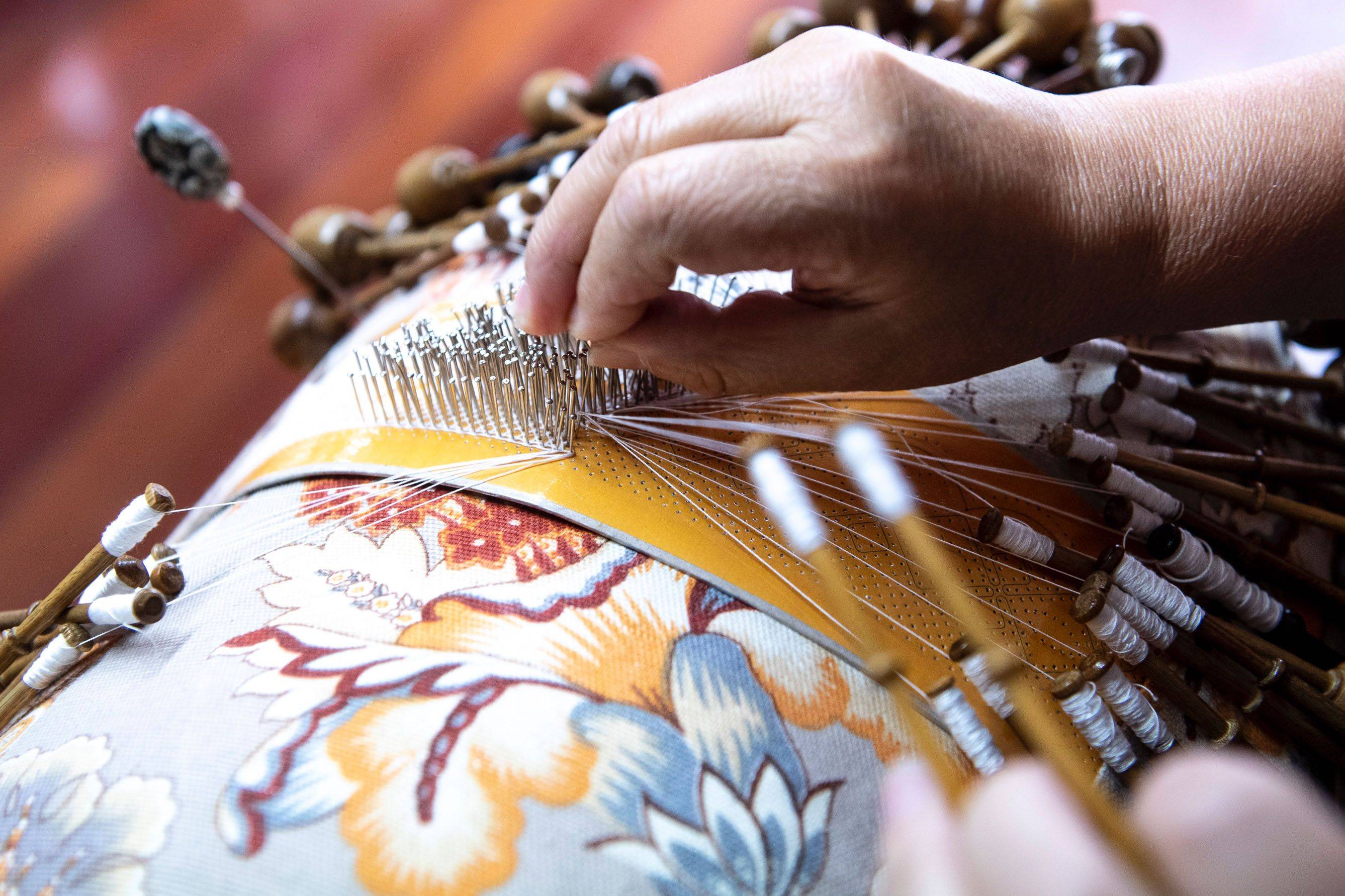
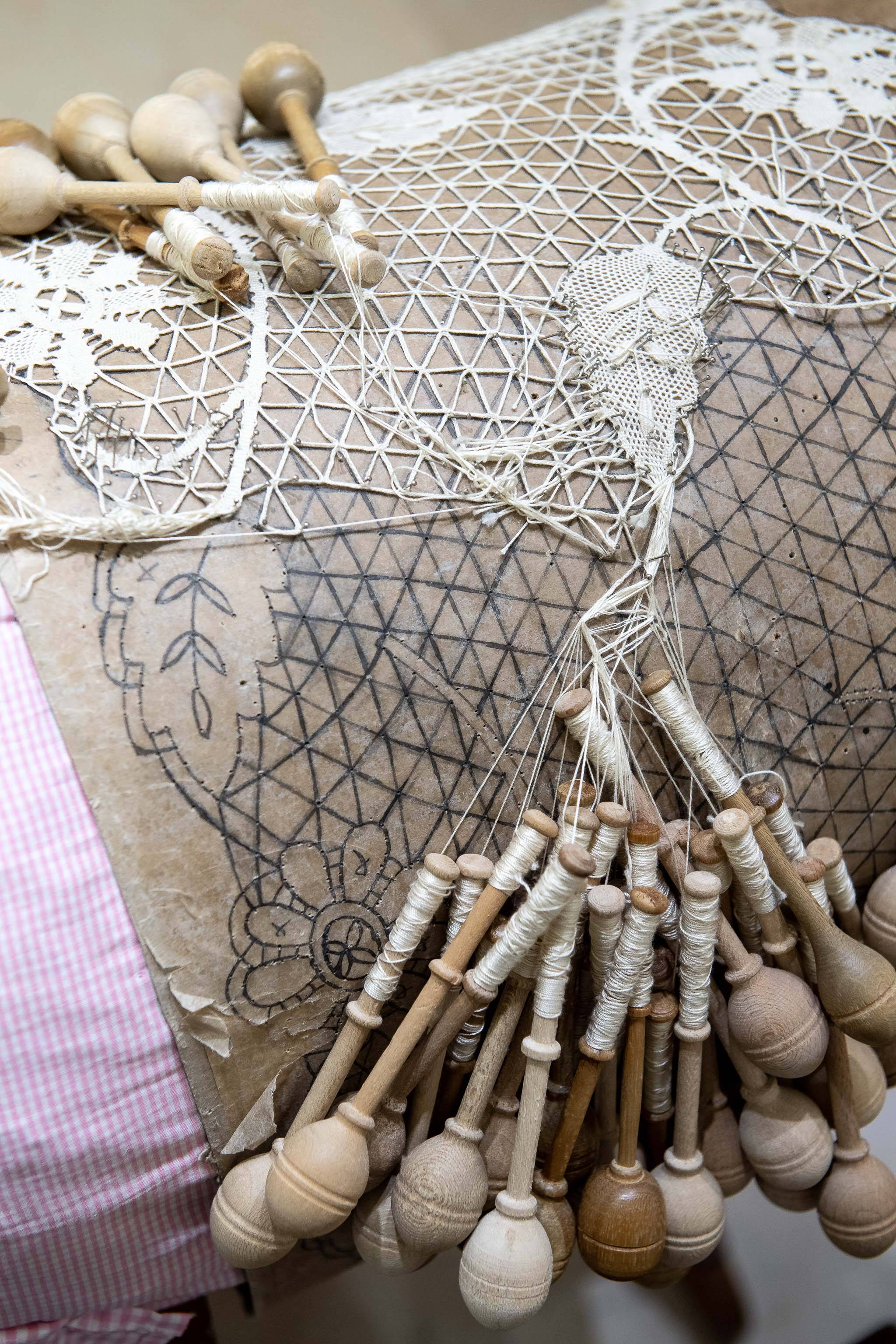
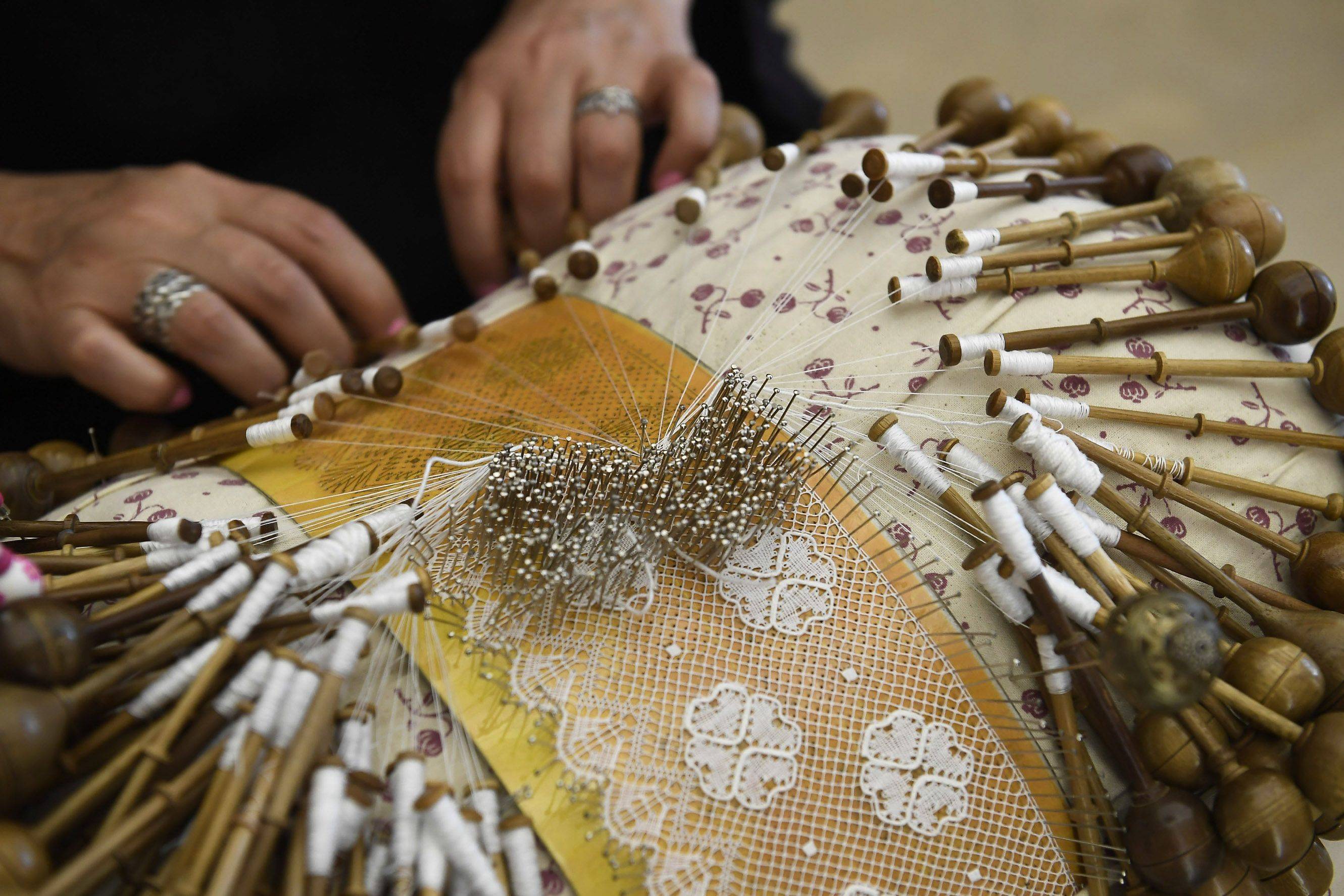
The production of bobbin lacework is a complex technique, requiring several years of practice to achieve mastery. Practice is fundamental to acquiring the necessary skill. Depending on the type of piece being made, the groups of bobbins can number in the hundreds. Each lacemaker has their own pillow or rebolo (the term used in Nisa). This cylindrical pillow, with a longitudinal opening from one side to the other to facilitate transportation, is covered with calico cotton or a similar fabric in a colour that contrasts with the white lace. It is packed with straw or another material to give it some rigidity without being too heavy, and to allow the pins to penetrate easily. The pillow is supported on a base or easel, which can be made of wood, wicker or cane, so that the pillow is at chest height when the lacemaker is seated. There are, however, some archive images which show the work being carried out with the lacemaker sitting on the floor, with the pillow supported on a low basket or in her lap.
Bobbins are the main element for this kind of lacemaking and they have emotional value and personal symbolism. A group of bobbins can be composed of several dozen. They are made of wood, traditionally carved with a pocket knife by the lacemaker’s family, or her boyfriend, who might give her bobbins as a symbol of affection. Nowadays, they are lathe-turned and, consequently, more uniform. The most common wood is pine, although some of the oldest bobbins used box or camellia. Some bobbins , which are regarded as better quality, are made from exotic woods. The uniformity and weight of the bobbins are characteristics that give them greater efficacy and make them easier to control with the hands. Each bobbin, or bilro, is formed of a thin wooden cylinder, finished at one end with a small sphere or protuberance, which is repeated halfway along the cylinder, marking the area around which the thread is wound. At the other end is a larger sphere or an oval shape, which is where the lacemaker’s fingers will hold it. In Portugal, bobbins that end in a sphere are more typical, but when they appear with an oval shape they are known as bilretas (EPV/ CEEV, 1982: 146). Each thread corresponds to its own bobbin.
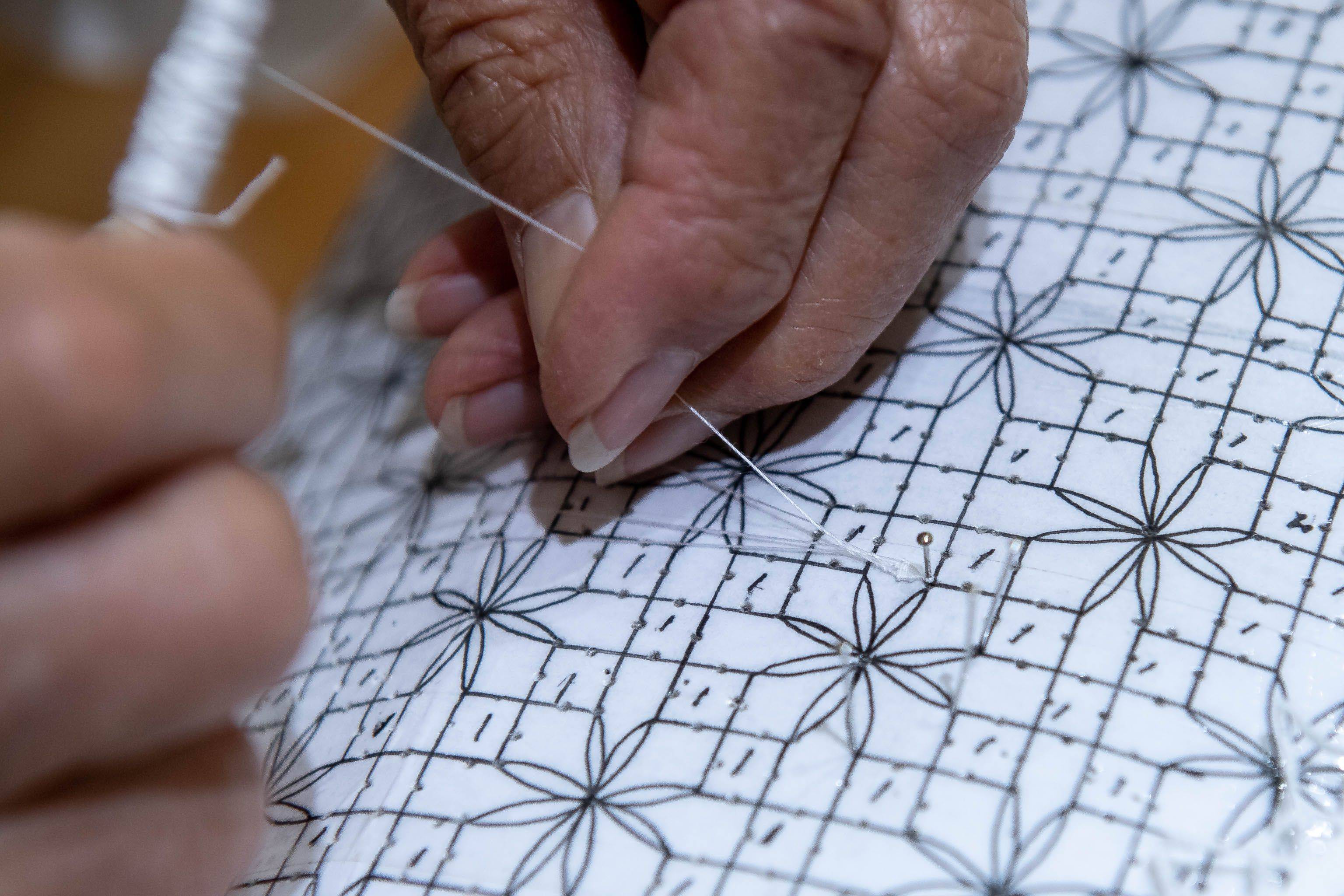
The third fundamental element in bobbin work is the pricking, where the design is marked out using perforations. It is the pricking that determines the number of bobbins to use and the sequential order in which they must cross to achieve the desired lace stitches. The lacemaker uses two identical prickings which are placed in sequence as the lace progresses. This traditional process is sometimes dispensed with by more experienced workers, who produce the lace directly over the design, without relying on the pricking's markers.
The lacemaker also needs many pins, scissors and thread. Until the mid-20th century, when Portuguese linen production was significant, linen thread was used, often spun by the lacemakers themselves, who grew the plants. In the second half of the century, cotton thread became more widespread, with no. 20 (very fine) being the most commonly used thickness, always in white (EPV/CEEV, 1982: 148).
Bobbin lacework is typically very fine and delicate, with a world of stitches and patterns that allow for hugely diverse results. Bobbin lacework can be recognised by the ground/field, which is the basis of the piece, resembling a fine net, which alternates with areas that are more or less filled in, sometimes with elements woven in to create a relief or compose ornamental designs. The stitch used to create the ground is called passadeira, ‘brides’ or mesh ground. The most commonly used stitches to create motifs are ponto de panhi (cloth stitch), meio ponto (half stitch), ponto de bruxelas (Brussels stitch), ponto de palhinha (basket stitch), ponto de rosa ou de casamento (rose or wedding stitch), and ponto valenciano (Valenciennes ground). There are also the following finishing stitches: Fita de pé (lit. foot ribbon) which is a kind of selvedge; pontinha or coroa which finishes off the underside of the lace and the pé which makes a twisted cord to finish the lower edge (MAGALHÃES, 1959).
To make a piece of lace, the lacemaker starts with the design, which is transferred to the ‘card’ or ‘pricking’, which acts as a guide for the construction of the lace. The card or pricking is then pierced according to the outline of the design. After the holes are made, the design is drawn over with a pen, highlighting the motifs that will adorn the lace. In a group of embroiderers, this task is the responsibility of the ‘prickers’, who are specialist lacemakers.
The technique allows lacemakers to work with an unlimited number of threads, each corresponding to a bobbin. The work is created by moving groups of four bobbins at a time, two in each hand. It is by crossing and twisting the threads in different ways that the different stitches are formed to construct the lace. The lacemaker moves the bobbins in a complex sequence of rotating movements, holding them between thumb and index finger, passing some bobbins over others to cross the threads in a particular way to obtain the desired stitch. The design is defined by the pins that, stuck vertically into the pillow, structure the sequence of knots and ensure that the ground remains firms. As the lace progresses, the pins are moved to the next area of the design. Once the lace is ready, it is time for the darner to sew the various sections of lace, that is, to join them as invisibly as possible to create the final piece (PERDIGÃO: 261).
According to the description by Calvet Magalhães (1959), the following steps are alternated to produce a piece of lace:
- Correr o bilro ou puxar a linha (pass the bobbin or pull the thread): move the bobbin in a certain way to loosen the loop so that the thread left between the lace and the bobbin will lengthen.
- Cobrir (cover): cover the outline or pricking by making the lace over it;
- Dar a volta (twist): pass the right-hand bobbin once, twice or more times over the left-hand bobbin of the same pair;
- Cruzar (cross): pass the bobbin from the inside of the left pair over the inner bobbin from the right-hand pair, a move that requires two hands and two pairs of bobbins;
- Deitar a asa ou o laço (leave a handle or loop): make a loop in the thread wound onto the bobbin, so that the bobbin can stretch further without the thread unwinding;
- Encher os bilros (fill the bobbins): wind thread onto the bobbin using the thumb and index finger of the left hand to hold and stretch the thread, and the same fingers of the right hand to rotate the bobbin.
- Espetar or pregar (prick or pin): place pins into the holes in the pricking, after completing the stitch;
- Tirar (pull): lift the pins from the holes in which they were initially placed to ensure the ground is conserved; these pins are used again in the lace;
- Torcer (roll): rotate the bobbin, so that the thread is firmly wound onto it.
In terms of the themes that appear in the lace designs, plant and floral motifs are predominant, stylising and simplifying the outline in the representation of flowers, wheat sheaves and leaves. Also common are geometric elements such arches, squares and lozenges. In Vila do Conde, in the mid-20th century, designs with a seaside theme were common, featuring conch shells, limpets, cowries, algae, fish and starfish (MAGALHÃES: 1959). The expressiveness of these motifs is achieved by using a range of stitches, chosen with creativity and in-depth knowledge of the technique. The ground of the lace, which serves as a canvas for the motifs, is a fine mesh, composed of larger or smaller openings, according to the desired effect. The ‘full’ areas are created using cloth stitch, half stitch with twist or crivo (sieve) stitch (EPV/ CEEV, 1979: 149)
Alongside the continued use of many traditional designs, which have been identified and characterised, new designs continued to be introduced. An original design demands both technical knowledge of design and knowledge of how lace is produced, in order to ensure the scheme’s suitability to the bobbin technique. (PERDIGÃO: 254).
In Peniche, designs are classified according to the typologies ‘erudite’ and ‘popular’. Popular lace is ‘lace where the motifs in the design are linked to each other tranças and pastilhas (plaits and tallies) where the ground, with rows or other stitches, link geometric motifs outlined with a thicker thread called torçal (gimp).’ Erudite lace is ‘composed of ornamental designs with floral motifs and others of great beauty and increasing difficulty of execution, in which thinner threads are used and varied background stitches, including tule stitch, which has recently been replaced in favour of simpler stitches, such as open or closed rows’ – Ida Guilherme (PERDIGÃO: 258).
Bobbin lacework from Vila do Conde uses 13 different stitches and 79 different motifs, both naturalist and geometric (2005 study). This diversity is one of the luxuriances of this lace and has facilitated its development and adaptation to each period, ensuring its continuity (RÊGO, 2005: 249).
Before the existence of industrial lace, bobbin lacework was sought-after for all kinds of luxury textile decorations, clothing and for domestic use. Collars and cuffs, inserts for dresses, ladies’ gloves and handkerchiefs are just some examples of the applications of this lace. Household linen also used a great deal of lace, in towels, napkins, sheets, curtains, etc.
The art of bobbin lacework has undergone dwindling periods, with a drastic drop in demand. However, the lacemakers, with their unique knowledge, have kept this art alive over time, through passion and tradition.
Nowadays, lacemaking is being seen in a new light, less as a source of income and more as the preservation of cultural heritage (RÊGO, 2005: 249).
Local and regional entities have created tools to develop and promote bobbin lacework, understanding the importance of safeguarding it and its cultural and economic potential. Among the measures implemented are training schools; the creation of facilities like the Museu da Renda de Bilros (Bobbin Lacework Museum) in Vila do Conde; the promotion of national and international events, such as the International Bobbin Lacework Showcase in Peniche, which brings together lacemakers from all over the world with a specific programme centred on lace; the promotion of workshops and contests for innovation or the establishment of partnerships with other entities in related areas, for example, the Centro de Formação Profissional da Indústria Têxtil (Professional Training Centre for the Textile Industry), which are able to extend the use of bobbin lacework to other areas of the market. These initiatives are of huge importance in ensuring the link between communities and traditional artisanal production, promoting bobbin lacework not just as a consumer item, but above all as living heritage of great cultural importance. 118).
Bibliography
- BRANCO, Conceição; SIMÃO, Jorge (1997) Modos de Fazer. Guia do artesanato Algarvio. Faro: Região de Turismo do Algarve
- COCOZZA, Glauco de Paula; RAMOS, Tânia Biesl (2015) Anais 3° Colóquio de Pesquisa em Arquitetura e Urbanismo e Design Brasil-Portugal. Minas Gerais/ Lisboa: FAUeD-UFU/FAUL
- Escola Preparatória de Viseu / Centro de Estágio de Educação Visual (1982) Artes e Tradições de Viseu. Lisboa: Terra Livre
- LIMA, Rui de Abreu de; LIMA, Eglantine M. (1997) Artesanato tradicional português III: Algarve. Lisboa: Direção-Geral de Turismo / Associação Industrial Portuguesa
- MAGALHÃES, M. M. Calvet de (1959) Rendas e bordados tradicionais: iniciativa da Junta de Turismo da Costa do Sol. Estoril: Sociedade de Educação Social
- MAGALHÃES, M. M. Calvet de (1970) Bordados e Rendas de Portugal. Coleção Educativa, série N.º 10. Lisboa: Direcção-Geral do Ensino Primário, 3ª edição
- PERDIGÃO, Teresa. «Rendas de Bilros de Peniche, séc XX e XXI. O custo de uma sobrevivência a custo». In PIRES, Ana (2009) Fios: Formas e memórias dos tecidos, rendas e bordados. Lisboa: IEFP/ FIA
- PIRES, Ana; RÊGO, Pedro (2005) Rendas de Bilros de Vila do Conde. Vila do Conde: Associação para a Defesa do Artesanato e Património de Vila do Conde
- RAMOS, Graça; RÊGO, Pedro (2021) Caderno de especificações para a certificação da Renda de Bilros de Peniche. Peniche: Câmara Municipal de Peniche
- RÊGO, Pedro. «Rendas de Bilros de Vila do Conde». In PIRES, Ana (2009) Fios: Formas e memórias dos tecidos, rendas e bordados. Lisboa: IEFP/ FIA
- SANTOS, Miguel Dias (2006) Contributos para a história do ensino técnico profissional em Peniche. Peniche: Escola Secundária de Peniche
- VASCONCELOS, Joaquim; VIANA, Maria Teresa (1983) Indústrias Portuguesas. Estudos e materiais, 2. Lisboa: Instituto Português do Património Cultural
Webgrafia
- Rendas de Bilros. Tradição e património (2015). Faculdade de Letras da Universidade do Porto [disponível em artsandculture.google.com]
- A Renda de Bilros de Peniche [disponível em cm-peniche.pt]
- Rendas de Bilros de Peniche (2019) [disponível em e-cultura.pt]